
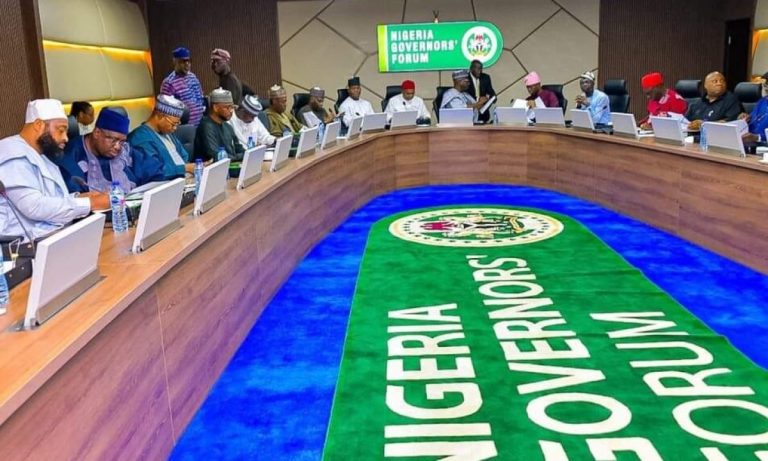
State governors have proposed greater constitutional authority over security operations within their domains and guaranteed funding arrangements for the proposed State Police Services as efforts to decentralise policing gather momentum.
According to Punch, the proposal formed part of recommendations contained in a report of a high-level strategic meeting involving state Attorneys-General, legal experts and senior security officials convened by the Nigeria Governors’ Forum (NGF) Secretariat in Abuja.
According to the report, the meeting was convened to harmonise proposals for a constitutional and institutional framework for the establishment of State Police Services across the country.
The document described the deliberations as “a significant milestone in ongoing efforts to strengthen the country’s security architecture through a decentralised policing system that balances local security needs with constitutional safeguards and national cohesion.”
The latest move comes amid growing concerns over insecurity, including terrorism, banditry, kidnapping, communal clashes and other violent crimes across the country.
Governors Seek Greater Security Role
A key outcome of the meeting was the proposal for stronger constitutional recognition of governors’ roles in coordinating security matters within their states.
“The meeting also reviewed provisions currently under legislative consideration, particularly clauses relating to the authority of governors in directing security operations within their states,” the report stated.
It added that participants emphasised “the importance of recognising the constitutional role of governors in coordinating security matters within their states while establishing safeguards for professionalism, accountability and operational independence.”
Currently, governors are regarded as chief security officers of their states but exercise limited control over police operations because the Nigeria Police Force remains under federal command.
The report outlined a policing model based on cooperative federalism, with clearly defined responsibilities for federal and state police institutions.
Under the proposed framework, the Federal Police Service would retain exclusive responsibility for offences of national importance.
“Under the proposed framework, the Federal Police Service would retain exclusive responsibility for offences of national significance, including terrorism, treason, narcotics-related crimes and interstate criminal activities,” the report stated.
State Police Services, on the other hand, would handle offences within their constitutional jurisdiction.
“State Police Services would be empowered to prevent, investigate and support the prosecution of offences within their constitutionally assigned jurisdiction, particularly offences created under state laws,” the report added.
Stakeholders Seek Guaranteed Funding
Funding emerged as one of the major issues discussed during the meeting, with participants stressing the need for sustainable financing arrangements.
According to the report, stakeholders emphasised “the need for clear constitutional provisions guaranteeing sustainable financial support for state policing structures.”
The report further noted the need for predictable and sustainable funding mechanisms to prevent security financing from becoming discretionary and to ensure adequate resources for training, equipment and operational effectiveness.
Participants also considered complementary funding arrangements, including transitional federal support and State Security Trust Funds to encourage partnerships with the private sector.
The proposed framework recommends that serving members of the Nigeria Police Force be allowed to voluntarily transfer to State Police Services without losing their ranks, seniority or pension benefits.
“The proposed framework includes provisions allowing eligible federal police personnel to voluntarily transition into State Police Services, subject to agreed legal, administrative and welfare arrangements, without losing their rank, seniority or pension benefits,” the report stated.
Stakeholders, however, recommended that such arrangements should be time-bound to ensure effective workforce planning and institutional development.
Constitutional Amendment Process Underway
The recommendations are expected to feed into ongoing constitutional amendment efforts at the National Assembly.
Earlier this month, the House of Representatives passed a bill seeking to amend the 1999 Constitution to provide for the establishment of state police, while the Senate subsequently passed the bill for second reading and referred it to its Committee on Constitution Review for further consideration.
If adopted, the proposals would create a dual policing structure comprising federal and state police institutions operating side by side under clearly defined constitutional mandates, marking one of the most significant security reforms since Nigeria’s return to democratic rule in 1999.
🔎Stay updated: Set Mc Ebiscoo as a favorite source on Google to catch our stories first.
Favor is power above all obstacles. You will either need favor to move up in life or favor to stay up in many areas of life. Silent spiritual and beneficial power of favor for success, progress, attractive and enviable positions in life, at workplace, undertakings, business, politics, profession, leadership matters, kingship tussle, fame, power, people/crowd, etc. Get healings, spiritual prevention/protection. Overcome delay, rejection, envy, disfavor and achieve desires. For spiritual consultation, guidance, solutions, other matters, call/Whatsapp Dr. Faros on 07030514063. Powerful results, no side effect. All power to God.