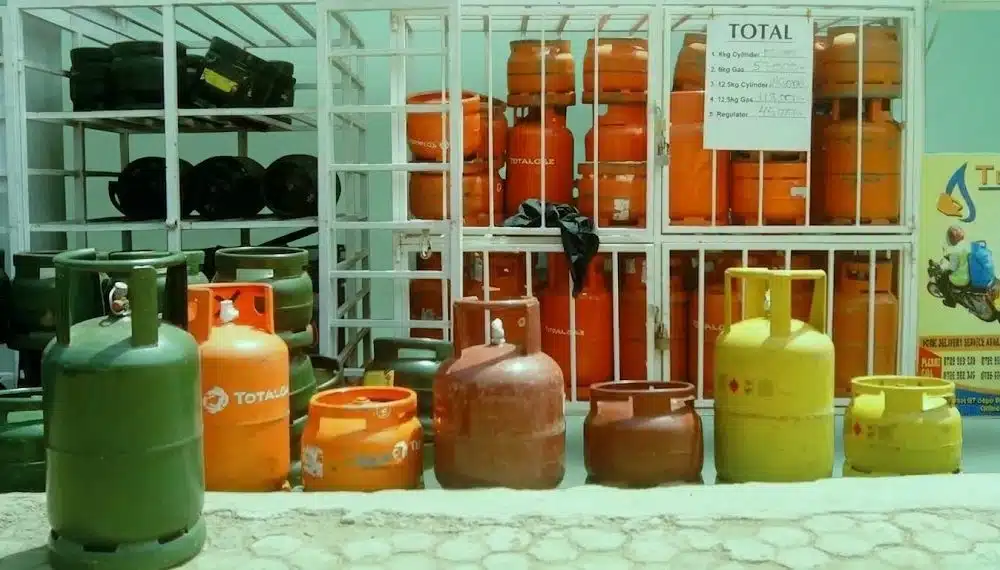
The price of Liquefied Petroleum Gas, popularly known as cooking gas, has increased significantly in Nigeria since the return to democratic government in 1999.
While reliable nationwide retail data for the first few years of the Fourth Republic are limited, available historical records show that one kilogramme of cooking gas could effectively be purchased for around ₦100 in the early 2000s.
More than two decades later, Nigerians are paying between ₦1,250 and ₦1,650 per kilogramme in some parts of the country, while prices crossed ₦2,000 per kilogramme during periods of scarcity in 2026.
The increase reflects decades of changes in domestic LPG production, imports, foreign exchange rates, transportation expenses, inflation, depot prices and supply shortages.
For consistency, this report uses the price of one kilogramme of cooking gas as its benchmark.
For years in which historical reports quoted only the price of a 12.5kg cylinder, the figures have been converted to their approximate per-kilogramme equivalents.
2002–2003: Around ₦100 Per Kilogramme
One of the most useful historical records comes from a World Bank LPG sector study conducted in Nigeria.
The study found that cooking gas in Lagos was generally sold for between ₦1,200 and ₦1,300 for 12.5kg.
Converted to a per-kilogramme basis, this amounted to approximately ₦96 to ₦104 per kg.
The lowest price encountered by the researchers was ₦950 for 12.5kg, equivalent to about ₦76/kg, while prices could climb to ₦1,800–₦2,000 during scarcity, or roughly ₦144–₦160/kg.
This means that around the early 2000s, ₦100 could buy roughly one kilogramme of cooking gas under normal market conditions in Lagos.
2004–2005: Around ₦130–₦150/kg, But Scarcity Causes Spike
By the middle of the decade, LPG prices began to fluctuate more sharply. Contemporary reports placed the cost of a normal 12.5kg refill around ₦1,700 during part of this period.
That translates to approximately ₦136 per kilogramme. During severe shortages, however, a 12.5kg cylinder was reportedly sold for as much as ₦5,500, equivalent to about ₦440/kg.
Such spikes were not necessarily representative of the normal nationwide price, but they showed how sensitive Nigeria’s LPG market was to supply disruptions.
2006: Around ₦208 Per Kilogramme
Cooking gas scarcity again affected consumers in 2006. A 12.5kg refill was reported at around ₦2,600 during the period.
This translates to about ₦208 per kilogramme. The increase represented a significant change from the roughly ₦100/kg obtainable only a few years earlier.
2007: Roughly ₦176–₦240/kg
By 2007, consumers were reportedly paying approximately ₦2,200 to ₦3,000 to refill 12.5kg cylinders.
On a kilogramme basis, that equals roughly: ₦176 to ₦240 per kg.
The year was also significant because Nigeria LNG expanded its domestic LPG supply programme, increasing the amount of cooking gas directed into the Nigerian market.
2008–2010: Around ₦160–₦240/kg
Cooking gas prices remained relatively moderate during the latter years of the Umaru Musa Yar’Adua administration and the beginning of the Goodluck Jonathan era.
Historical market reports surrounding this period suggest prices of roughly ₦2,000 to ₦3,000 for 12.5kg under normal conditions.
This would place the equivalent retail price at about ₦160 to ₦240 per kilogramme.
The figures should, however, be treated as indicative market prices rather than official nationwide annual averages.
2011: Price Rises To ₦240–₦280/kg
Another LPG shortage hit consumers around late 2010 and early 2011. A 12.5kg refill was reported at between ₦3,000 and ₦3,500.
Converted into the 1kg benchmark, Nigerians were paying approximately ₦240 to ₦280 per kg. Supply constraints were among the major reasons cited for the increase.
2012: Around ₦240–₦280/kg
Prices remained within a similar range during much of 2012. A standard 12.5kg refill reportedly cost between ₦3,000 and ₦3,500 in Lagos and Ogun.
That represents approximately ₦240 to ₦280 per kilogramme. During December scarcity in places such as Umuahia, however, the price climbed much higher.
2013: ₦200–₦240/kg Before Scarcity
Normal prices reportedly moderated to around ₦2,500–₦3,000 for 12.5kg during parts of 2013.
This works out at approximately ₦200–₦240/kg.
But supply disruptions again pushed a full 12.5kg refill to between ₦4,000 and ₦5,000 in some places, equivalent to about ₦320–₦400/kg.
The sharp difference between normal and scarcity prices remained a recurring feature of Nigeria’s gas market.
2014: Around ₦224–₦280/kg
In 2014, a 12.5kg refill was reported around ₦2,800 to ₦3,500 in parts of the market.
Converted to one kilogramme, consumers were paying approximately ₦224 to ₦280.
Domestic supply from NLNG was credited with helping to reduce some of the extreme scarcity prices previously recorded.
2015: Around ₦264–₦280/kg
Towards the end of the Goodluck Jonathan administration and the beginning of Muhammadu Buhari’s presidency, cooking gas remained far cheaper than current levels.
With 12.5kg generally around ₦3,300–₦3,500, the equivalent price was approximately ₦264–₦280 per kilogramme.
From the following years, more consistent National Bureau of Statistics data became available.
2016: About ₦326/kg
By December 2016, the average price for 12.5kg stood at about ₦4,071.63.
This is equivalent to approximately ₦325.73 per kilogramme.
The figure provides a useful starting point for comparing the more systematic NBS price series used in subsequent years.
2017: About ₦356/kg
The NBS said the average retail cost of refilling a 12.5kg cylinder reached ₦4,452.83 in December 2017.
Converted to a per-kilogramme benchmark, the national average was approximately ₦356.23/kg.
2018: About ₦347/kg
Cooking gas prices eased slightly in 2018. The NBS recorded a national average of ₦4,332.06 for 12.5kg in December.
That represents approximately ₦346.56 per kilogramme.
2019: About ₦334/kg
Prices fell further in 2019. The December national average for a 12.5kg refill was ₦4,176.20, according to the NBS.
This gives an equivalent price of approximately ₦334.10/kg.
2020: About ₦332/kg
Cooking gas prices remained remarkably stable during 2020 despite the disruption caused by the COVID-19 pandemic.
The NBS recorded ₦4,154.28 as the average December price for 12.5kg.
That amounted to approximately ₦332.34 per kilogramme.
The figure means that at the end of 2020, ₦1,000 could theoretically buy about three kilogrammes of LPG at the national average.
2021: Price Jumps To About ₦587/kg
The relatively stable market changed dramatically in 2021. By December, the NBS said a 12.5kg refill averaged ₦7,332.04, up 76.49 per cent from ₦4,154.28 in December 2020.
On a kilogramme basis, the price rose from approximately ₦332/kg to ₦586.56/kg.
This marked one of the sharpest annual increases in the country’s modern LPG market.
2022: About ₦820/kg
The increase continued throughout 2022. By December, the average price of 12.5kg had climbed to ₦10,248.97.
This translates to approximately ₦819.92 per kilogramme.
For the first time in the NBS series, the year-end equivalent price was approaching ₦1,000/kg.
2023: About ₦921/kg
Cooking gas remained expensive throughout 2023. The NBS put the average 12.5kg refill at ₦11,510.16 in December 2023, representing a 12.31 per cent year-on-year rise.
Dividing that by 12.5 gives an equivalent price of ₦920.81/kg.
2024: Price Crosses ₦1,300/kg
The situation became considerably more difficult for households in 2024.
The average 12.5kg refill reached ₦17,274.16 in December 2024, compared with ₦11,510.16 a year earlier.
That means Nigerians were effectively paying an average of ₦1,381.93 per kilogramme.
The NBS said the 12.5kg price had risen by more than 50 per cent year-on-year.
2025: Gas Peaks Around ₦1,681/kg Before Falling
Prices continued rising during the first half of 2025.
The NBS reported that 12.5kg reached ₦21,010.56 in June, compared with ₦20,709.11 in May. That translates to approximately ₦1,680.84/kg.
However, the market changed considerably during the second half of the year. By December, a 12.5kg refill had fallen to ₦13,438.90, according to the NBS.
The equivalent December price was therefore approximately ₦1,075.11/kg.
This meant cooking gas ended 2025 substantially below the peak recorded earlier in the year.
January 2026: Around ₦1,084/kg
The average 12.5kg refill opened 2026 at approximately ₦13,551. Converted to a kilogramme basis, this was roughly ₦1,084/kg. However, the relief did not last.
March 2026: Price Surges To ₦1,572/kg
By March, the national average for refilling a 12.5kg cylinder had surged to ₦19,652.83.
That translates to approximately ₦1,572.23 per kilogramme. The NBS also recorded a 5kg refill at ₦7,655.73 during the month.
April 2026: About ₦1,791/kg
The upward movement continued in April.
The national average for 12.5kg climbed to ₦22,382.20, representing a 13.89 per cent increase from March.
Converted to the one-kilogramme benchmark, the price was approximately ₦1,790.58/kg.
This was more than 17 times the roughly ₦100/kg market price recorded in Lagos during the early 2000s, although the comparison is in nominal naira terms and does not adjust for inflation.
Retail prices in some locations climbed even closer to or above ₦2,000/kg during shortages.
August–September 2026: ₦1,250–₦1,650/kg In Parts Of Nigeria
Prices have since moderated from the peaks recorded earlier in 2026.
Data attributed to the Nigerian Midstream and Downstream Petroleum Regulatory Authority (NMDPR) showed that in July, average retail LPG prices among six major cities ranged from ₦1,325/kg in Lagos to ₦1,575/kg in Sokoto.
Meanwhile, a Naija News survey found that consumers were paying between ₦1,250 and ₦1,650 per kilogramme, depending on their location and point of purchase.
In Lagos and Ogun, separate August market checks placed retail prices around ₦1,400–₦1,500/kg at some outlets.
Add Newshour as a preferred source on Google
Select Newshour on Google to see our articles more often in Google Search and Top Stories.