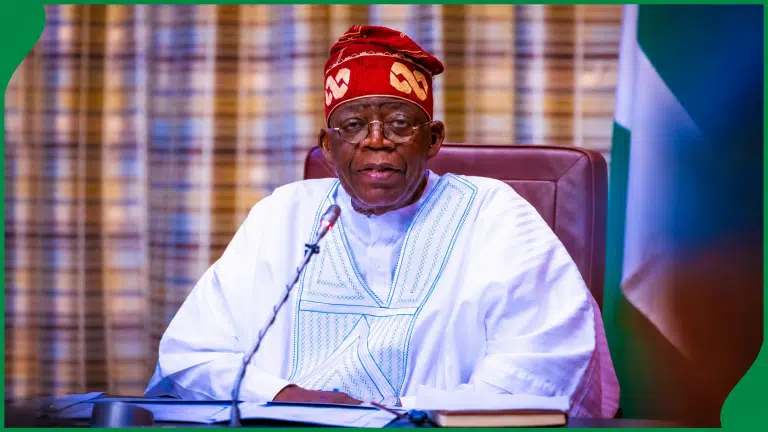
President Bola Tinubu on Thursday said Nigerians were free to criticise his administration and even direct insults at him without fearing retaliation from the government.
Naija News reports that the President said his administration’s willingness to accommodate dissent reflected its commitment to freedom of expression and an independent press.
Tinubu stated this at the centenary celebration of the Daily Times of Nigeria Limited in Abuja, where he was represented by the Secretary to the Government of the Federation, George Akume.
Akume quoted the President as saying, “Let us admit that under this government, you can insult and attack the president and still go to bed without midnight troubles. This philosophy lies at the heart of the Renewed Hope Agenda.”
Beyond press freedom, Tinubu used the occasion to defend the economic and institutional reforms undertaken by his administration, arguing that many of Nigeria’s difficulties were inherited from structural problems that developed over several decades.
He maintained that addressing such longstanding challenges required difficult decisions rather than short-term interventions.
According to the President, the government’s reform programme should therefore be viewed as an attempt to alter the country’s long-term economic direction rather than merely a collection of policy changes.
The reforms, he said, “are about changing the trajectory of our nation.”
Tinubu listed strengthening Nigeria’s fiscal position, increasing economic productivity, improving institutions and infrastructure, attracting investment and creating more opportunities for young Nigerians among the administration’s priorities.
He said the ultimate objective was to position Nigeria to compete more meaningfully and purposefully in the global economy.
Tinubu also acknowledged the media’s influence on national development, saying journalism has an important role in documenting the country’s experiences and holding institutions accountable.
Reflecting on the Daily Times’ 100 years of existence, he described the milestone as evidence of the newspaper’s ability to survive different phases of Nigeria’s political and social development.
The president said, “One hundred years is not an anniversary; it is a testament to endurance, relevance and institutional resilience.”
He noted that the newspaper had played roles beyond reporting events, describing it as an important participant in interpreting and documenting Nigeria’s development.
Tinubu also stressed the importance of preserving historical records, warning that societies could repeat past failures when they failed to learn from their experiences.
“A nation that forgets its history is at risk of repeating its mistakes, but a nation that understands its history can draw wisdom from its successes, learn from its setbacks and confidently design its future,” he said.
At the event, the President unveiled the Nigerian Grand Book, a publication intended to document Nigerians who have contributed to the country’s development across different sectors.
Tinubu said preserving such records would help future generations understand the individuals and institutions that shaped the country.
“History should not be a museum of yesterday. History should be an instrument of engineering tomorrow,” he said.
Add Mc Ebisco as a preferred source on Google
Select Mc Ebisco on Google to see our articles more often in Google Search and Top Stories.