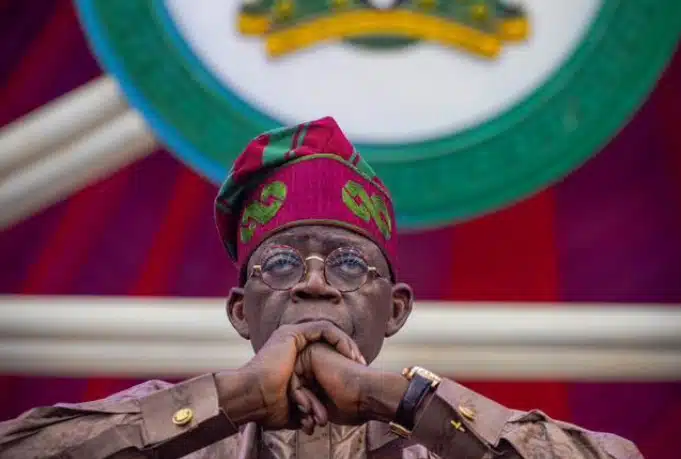
President Bola Tinubu’s government has been warned that Nigeria could soon witness an even more disturbing situation where fake government structures emerge and begin receiving public funds if the authorities fail to strengthen oversight and accountability.
The warning was issued by the Executive Director of the Center for Information Technology and Development, Y. Z. Ya’u, following the discovery of an organization allegedly operating as a government agency within the federal government structure.
Nigeria May Soon Have Fake States, Governors
“I wonder why Nigerians are surprised that there are fake agencies within the federal government. It is the height of naivety to expect anything other than this,” Ya’u said in an interview with Daily Post.
“Soon, if we are not careful, we have fake state with fake Governor and State Assembly getting allocation from the federation account,” he warned.
Naija News reports that his comments came amid growing concerns over how organizations with questionable government status have allegedly managed to operate from government premises and present themselves as official institutions.
The latest case involves the National Brands Development and Made-in-Nigeria Special Project Office, which the Independent Corrupt Practices and Other Related Offences Commission (ICPC) described as an unauthorized organization allegedly operating from a government building in Abuja.
The ICPC Chairman, Dr Musa Adamu Aliyu, SAN, said the organization was allegedly promoted by George Buchi Nwabueze, who was said to have used different variations of his name.
Following a briefing by the ICPC, President Bola Tinubu ordered Nwabueze’s arrest and the suspension of three permanent secretaries in the Office of the Secretary to the Government of the Federation.
The development has triggered fresh questions over the ability of government institutions to detect and stop questionable organizations operating within official structures.
Vice-President of the Nigerian Political Science Association, Professor Murtala Muhammad, said the situation should not be treated simply as a case of individuals allegedly creating fake organizations.
He described it as “fundamentally a governance and institutional failure, rather than merely a case of individual criminality.”
Muhammad said weak rules, poor verification systems, and inadequate oversight created room for private individuals to exploit the authority and credibility associated with government.
“Where rules, verification mechanisms, enforcement and oversight are weak, private actors can appropriate the authority and legitimacy of the state,” he said.
He added that the alleged creation of offices and appointment documents by the disputed Presidential Foreign Intervention Promotion Council pointed to serious weaknesses within the government’s administrative system.
“The alleged creation of offices, fabrication of appointment documents and efforts to present the organization as a legitimate government institution point to serious weaknesses in bureaucratic verification and institutional accountability,” Muhammad said.
The political analyst said the controversy surrounding the Presidential Foreign Intervention Promotion Council (PFIPC) was particularly troubling because of reports that the organization allegedly sought a ₦1.3 billion budgetary allocation.
“The reported attempt by the PFIPC to secure a ₦1.3 billion budgetary allocation is especially disturbing because it suggests that institutional vulnerabilities may extend into the fiscal architecture of government,” he said.
According to him, the problem is also connected to poor governance, corruption, weak coordination among government agencies, and inadequate accountability within the public service.
‘Fake Agencies Do Not Emerge In Vacum’
Muhammad urged the government to strengthen the verification of agencies and appointments, improve information sharing, and introduce tighter controls around budgetary processes.
“Fake agencies, therefore, do not emerge in a governance vacuum; they thrive where corruption, administrative weakness and inadequate accountability create the institutional space for their operation,” he said.
Governance expert and public commentator, Dr Joe Abah, also suggested that the problem may extend beyond the two cases currently under investigation.
Abah said there were several organizations operating around government offices that could easily create the impression of being official bodies.
“Another day, another ‘fake agency.’ There are all sorts of bodies that have offices in the Office of the Secretary to the Government of the Federation and the Federal Secretariat,” Abah wrote on his official handle, Naija News reports.
He said some organizations only needed “a government-sounding name, a government-looking logo and an SGF address” to gain public confidence and raise money.
Abah recalled an experience from his time in government when an organization repeatedly offered him and his staff free foreign trips under the guise of a mentorship programme.
He said he became suspicious after the promoter could not clearly explain who established the organization or how it was funded.
“Interestingly, my civil servants, who would always welcome a foreign trip, never tried to convince me. They probably already knew what I could only sense, being new at the time, that it was advanced 419. Somebody really needs to sort out the Office of the SGF,” Abah added.
Meanwhile, former Minister of Youth and Sports, Solomon Dalung, has called for a wider investigation into the organization, particularly following reports that it had coordinators in about 20 states and representatives in China and the United States.
“Who appointed these coordinators? Who communicated those appointments? Who interacted with them as representatives of the organization?” Dalung asked.
He said the answers to those questions would be important in determining how far the organization had penetrated government structures.
Muhammad also warned that the controversy could have political consequences for the Tinubu administration ahead of the 2027 elections.
He said opposition parties could use the development to accuse the government of administrative incompetence, corruption or institutional capture.
“If Nigerians perceive that a fictitious agency could allegedly establish offices, create nationwide networks and penetrate government processes without timely detection, opposition parties will inevitably frame the episode as evidence of administrative incompetence, corruption or institutional capture,” he said.
However, he noted that the government could limit the damage by responding with transparency, holding those responsible accountable, and carrying out meaningful institutional reforms.
Meanwhile, Nwabueze, identified as the promoter of the organization, has rejected the description of the Made-in-Nigeria project as a phantom or unauthorized government agency.
His management said the initiative was an approved public-private project anchored on Executive Orders 003 of 2017 and 005 of 2018.
“The Made in Nigeria Project has never operated as, nor claimed to be, a statutory civil service agency,” the statement said.