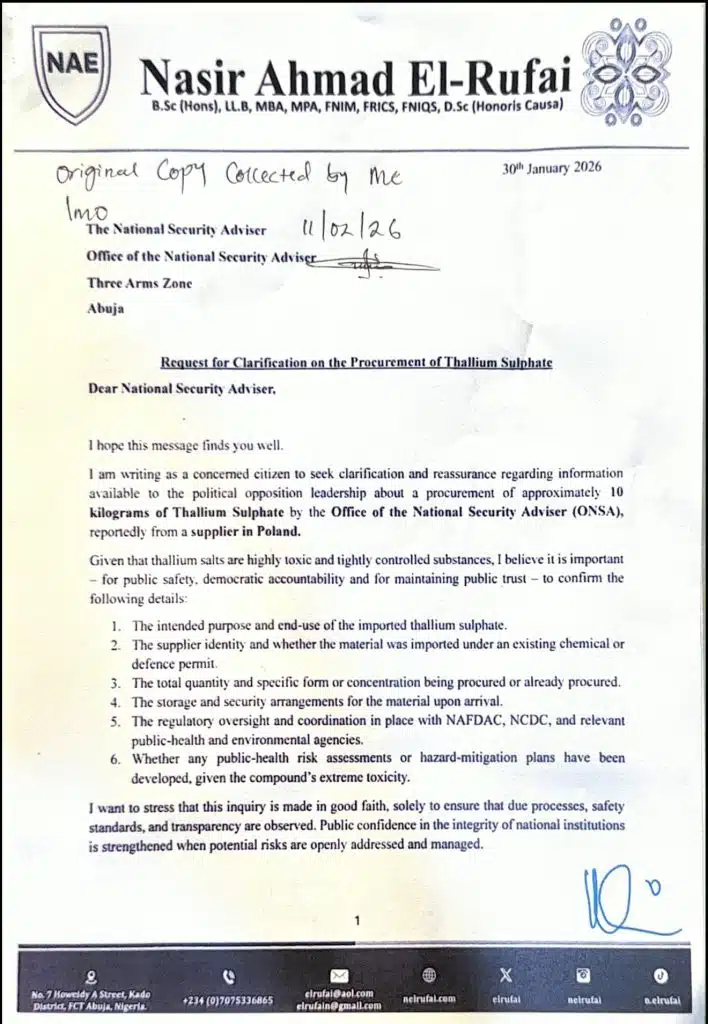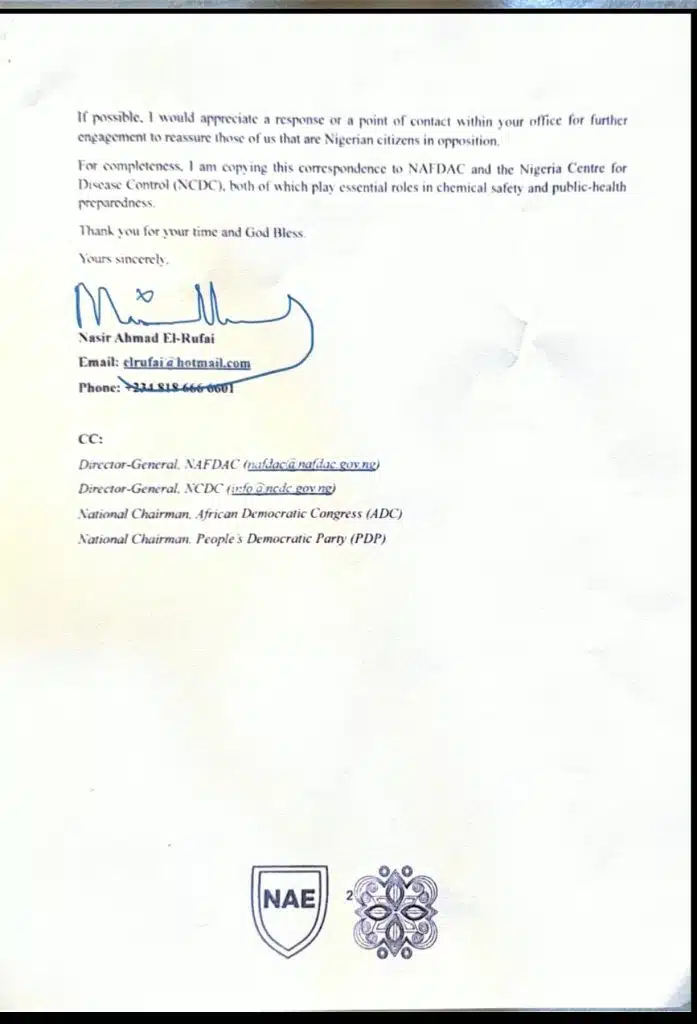

Former Kaduna State Governor, Nasir Ahmad El-Rufai, has accused the Office of the National Security Adviser of procuring thallium sulphate, a highly toxic chemical compound, and demanded urgent clarification over the alleged transaction.
El-Rufai made the allegation on Sunday in a post on , where he shared a copy of a letter addressed to the Office of the National Security Adviser in Abuja.
“As part of my duty as a citizen, I wrote to the NSA to seek clarification on reports about the importation by his office of thallium sulphate, a very dangerous toxin. It’s a matter of concern if anyone brings in any poison, more so an odourless, colourless one,” El-Rufai wrote.
The letter reads, “Dear National Security Adviser. I hope this message finds you well.
“I am writing as a concerned citizen to seek clarification and reassurance regarding information available to the political opposition leadership about a procurement of approximately 10 kilograms of Thallium Sulphate by the Office of the National Security Adviser (ONSA), reportedly from a supplier in Poland.
“Given that thallium salts are highly toxic and tightly controlled substances, I believe it is important for public safety, democratic accountability and for maintaining public trust to confirm the following details:
“1. The intended purpose and end-use of the imported thallium sulphate.
“2. The supplier identity and whether the material was imported under an existing chemical or defence permit.
“3. The total quantity and specific form or concentration being procured or already procured.
“4. The storage and security arrangements for the maserial upon arrival
“5. The regulatory oversight and coordination in place with NAFDAC, NCDC, and relevant public-health and environmental agencies.
“6. Whether any public-health risk assessments or hazard-mitigation plans have been developed, given the compound’s extreme toxicity.
“I want to stress that this inquiry is made in good faith, solely to ensure that due processes, safety standards, and transparency are observed. Public confidence in the integrity of national institutions is strengthened when potential risks are openly addressed and managed.” See more