This comes as President Bola Tinubu declined a request to personally receive a special envoy from South African President Cyril Ramaphosa amid growing concerns over repeated attacks on Nigerians living in the country.
The South African government has acknowledged that it remains permanently indebted to Nigeria for the pivotal role the country played in the struggle that ended apartheid.
This comes as President Bola Tinubu declined a request to personally receive a special envoy from South African President Cyril Ramaphosa amid growing concerns over repeated attacks on Nigerians living in the country.
Instead of meeting the South African delegation himself, President Tinubu delegated the engagement to Nigeria’s Minister of State for Foreign Affairs, Ambassador Sola Enikanolaiye, during talks held in Abuja on Monday.
The South African delegation was led by the country’s Minister of International Relations and Cooperation, Ronald Lamola, who disclosed that he had been sent by President Ramaphosa to deliver a special message to President Tinubu aimed at reinforcing bilateral relations and addressing concerns surrounding the safety of Nigerians and other African nationals in South Africa.
Speaking at the meeting, Lamola paid glowing tribute to Nigeria’s historic support for South Africa’s liberation struggle, saying the South African people would never forget the sacrifices made by successive Nigerian governments and citizens in the fight against apartheid.
“We remain deeply indebted to the people of Nigeria for their sacrifice,” Lamola said.
He noted that Ramaphosa’s administration remained firmly opposed to xenophobia, racism, discrimination, homophobia and every form of intolerance.
According to him, South Africa remains committed to protecting everyone living within its borders irrespective of nationality.
However, Lamola maintained that Pretoria also has a constitutional obligation to enforce its immigration laws and tackle criminal activities, including drug trafficking, internet fraud and other transnational crimes.
“We believe that Nigeria and South Africa have a shared responsibility to respond to these challenges within the African continent,” he said, adding that migration had become a continental issue requiring cooperation under African Union protocols on orderly and regular migration.
Lamola said the details of President Ramaphosa’s message to Tinubu would be discussed during a closed-door session.
Responding on behalf of the Nigerian government, Enikanolaiye said President Tinubu specifically directed that the meeting should provide an opportunity for both countries to frankly discuss the persistent attacks on Nigerians residing in South Africa.
The Nigerian minister urged Pretoria to move beyond diplomatic assurances by taking concrete steps to end what he described as recurring Afrophobic violence targeting Nigerians and other African nationals.
He disclosed that official Nigerian records indicate that at least 98 Nigerians have been killed in mob attacks and hate-related violence in South Africa since 2022.
According to him, five Nigerians have already lost their lives this year, although some Nigerians recently repatriated from South Africa claimed the actual number of victims could be much higher.
“Nigeria will not support drug traffickers or any criminal activity, but those accused of crimes must be treated in accordance with the rule of law, South Africa’s Constitution and international human rights standards,” Enikanolaiye said.
He stressed that Nigeria does not shield criminals but insisted that anyone suspected of committing offences must be arrested, prosecuted and punished through lawful judicial procedures rather than subjected to mob violence.
The minister also questioned why South African security agencies had repeatedly failed to prevent attacks despite many victims being legally resident in the country.
He warned that the continued killings threaten decades of diplomatic cooperation between Africa’s two biggest economies and undermine the spirit of African unity.
Enikanolaiye further disclosed that nearly 1500 Nigerians had been repatriated from South Africa this year, describing many of their experiences as traumatic and emotionally devastating.
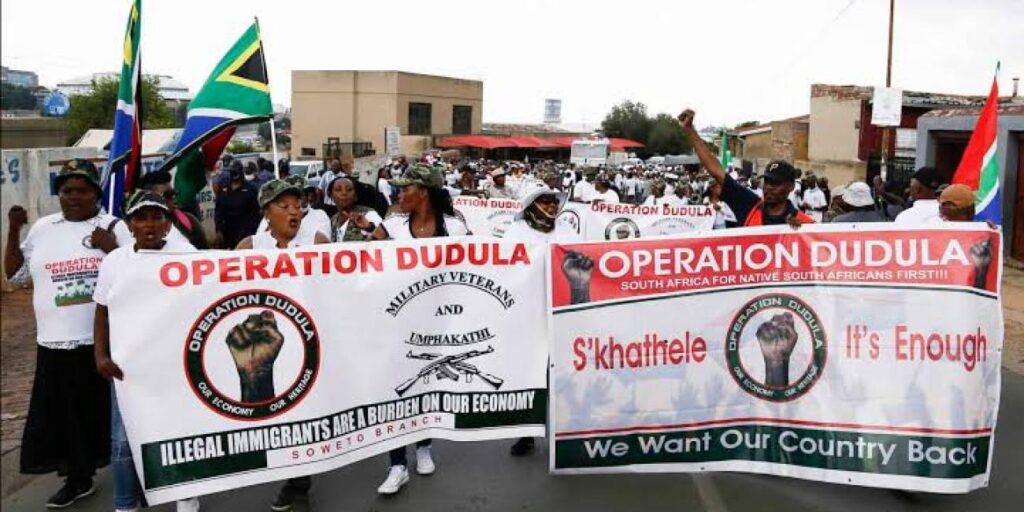
Relations between Nigeria and South Africa have increasingly come under strain over repeated outbreaks of xenophobic violence, with Nigerians frequently among the worst affected victims.
For decades, Nigeria was one of the strongest international supporters of South Africa’s anti-apartheid struggle. Successive Nigerian governments provided financial assistance to liberation movements, offered scholarships to South African students, imposed sanctions against the apartheid regime and mobilised diplomatic pressure for majority rule.
Many Nigerians have argued that those sacrifices have not been reciprocated since South Africa’s democratic transition in 1994, citing repeated attacks on Nigerian businesses and residents.
Major waves of xenophobic violence erupted in 2008, 2015 and 2019, leaving dozens of African migrants dead, hundreds injured and businesses looted or destroyed. Nigerians were among those killed, while many others lost property worth millions.
The 2019 attacks triggered widespread outrage in Nigeria, leading to retaliatory protests outside South African-owned businesses, including MTN and Shoprite outlets.
The Nigerian government subsequently boycotted the World Economic Forum on Africa hosted by South Africa, while then-President Muhammadu Buhari dispatched a special envoy to Pretoria to demand stronger protection for Nigerians.
In response to recurring violence, both countries established early-warning mechanisms and diplomatic channels intended to improve cooperation on migration, law enforcement and citizens’ welfare. Despite those efforts, attacks on foreign nationals have continued to fuel tensions.
Nigerian authorities have consistently maintained that while criminal suspects should face prosecution where evidence exists, no nationality should be collectively criminalised or exposed to mob justice.
Monday’s meeting in Abuja came against that backdrop, with Nigeria pressing South Africa to match its repeated condemnations of xenophobia with concrete measures capable of protecting Nigerians and ensuring perpetrators of attacks are brought to justice.