
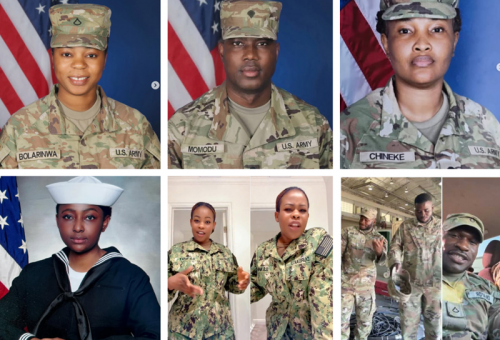
The recent enlistment of Nollywood actor Joseph Momodu into the U.S. Army has once again brought attention to a growing trend among Nigerians seeking opportunities in the American military.
Like others before him, his move has raised questions about what it takes for Nigerians to wear the U.S. Army uniform.
For anyone considering that path, the process begins long before recruitment.
But one important fact remains: Nigerians cannot join the U.S. Army directly from Nigeria.
Anyone interested must first move to the United States and become either a lawful permanent resident (Green Card holder) or a U.S. citizen.
There are no U.S. Army recruitment centres in Nigeria, which means the journey starts with immigration.
Over the years, other Nigerians, including celebrities, have also joined the U.S. military.
In 2024, actress and former beauty queen Princess Chineke relocated to the U.S. and enlisted in the Army.
Actress and producer Mayowa Dosu also joined the U.S. Army last year.
Likewise, Grace-Charis Bassey, formerly known as Belinda Effah, joined the U.S. Navy, a move that later earned her U.S. citizenship.
For Nigerians hoping to follow the same path, here are the basic steps:
Step 1: Move to the United States
According to Michael K, an officer in the U.S. Army, the first step is relocating to America legally.
“First you’re going to need to move to the US and become a legal resident. The US does not accept non-residents into its armed forces. Once you’ve moved to the US and are a resident then you can begin the enlistment process and join the US Army.”
Step 2: Get legal residency
To join the Army, you must have either a Green Card or U.S. citizenship.
Without one of these, enlistment is not possible.
Step 3: Meet the age requirement
Applicants must generally be between 17 and 42 years old.
Step 4: Have the right education
A high school diploma or its equivalent, such as a GED, is required.
If your academic certificate is from Nigeria, it must be evaluated to match U.S. standards.
Step 5: Pass the tests
Applicants must pass the Armed Services Vocational Aptitude Battery (ASVAB) and meet medical and physical fitness requirements.
Step 6: Pass background checks
The Army also carries out strict background and security checks.
Criminal records and moral conduct are taken seriously.
For those who want to become officers instead of regular soldiers, Michael K explained that the process is different.
“However, enlisting is not the same as commissioning as an officer. Whereas the US military will take non-citizen residents as enlisted personnel, it requires that all officers be US citizens.”
He said there are two ways to achieve this.
Option one is to move to the U.S., wait for five years, apply for citizenship, and then join through Officer Candidate School (OCS).
“Then, once you obtain your citizenship, you go to an Army recruiter. You would then go through the recruitment process for a ‘college option’ OCS candidate. You’d ship to Basic Training then off to OCS. This path will probably take something like 8+ years.”
The second option is to enlist first and then apply for citizenship while serving.
“Option 2: You move to the US and immediately talk to a recruiter and enlist as a regular Soldier in the US Army.
Military service will greatly reduce the required residence period from 5 years down to just 1 year of military service, and you’re likely to also get a more expedited naturalization process.
Once you do get your citizenship (and have been in the Army already a year or two as an enlisted Soldier), you can then apply to OCS from within the ranks. This process might take more like 2+ years.”
One of the major benefits of joining the U.S. Army is faster citizenship.
Under U.S. immigration law, lawful permanent residents who serve honourably may qualify for citizenship much earlier.
Enlisting also gives access to education support through the GI Bill, as well as specialised training in different career fields.
For many Nigerians, the journey may be long, but for those determined, it remains a possible path.
Favor As Higher Power?
(The hidden truth)
Some positions in life cannot be held or retained for long if you are not favored. Favor is higher power. You are not the only one desiring, deserving, connected, powerful or qualified. Some positions in life, opportunities, success, achievements, triumphs, selection, approvals, power and position, elevation, patronage, etc, are mainly through favor. Favor is silent, spiritual and higher power. For spiritual guidance, other solutions, call/Whatsapp Dr J.A. Faros on 07030514063. With God, all are possible.