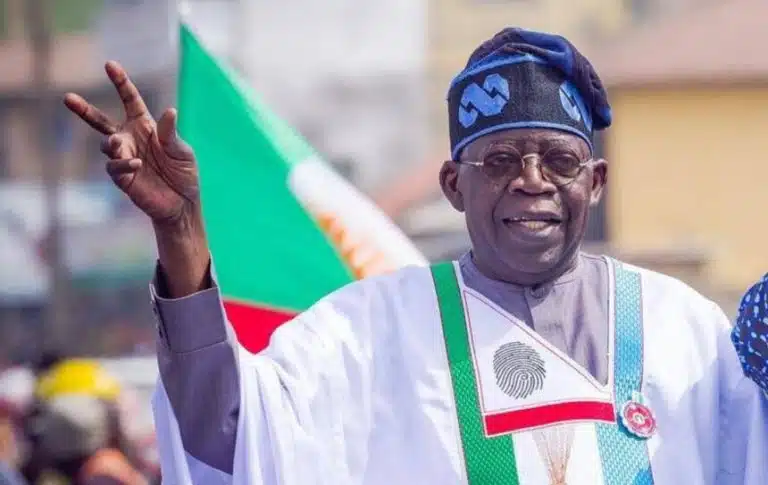
A Senior Advocate of Nigeria (SAN), Wole Afolabi, who is part of President Bola Tinubu’s legal team in the United States, has dismissed claims linking the Nigerian leader to drug trafficking, arguing that American authorities would have prosecuted him if credible evidence existed.
Naija News reports that Afolabi stated this during an appearance on Channels Television’s Sunday Politics, where he addressed the controversy surrounding efforts to obtain investigative records on Tinubu from various US law enforcement agencies.
The records are at the centre of a Freedom of Information Act lawsuit filed by Aaron Greenspan against the United States government.
Greenspan is seeking documents held by the US Department of Justice, Federal Bureau of Investigation (FBI) and Drug Enforcement Administration relating to past investigations involving Tinubu.
According to Afolabi, the US authorities have already released thousands of pages of documents but are resisting demands for the disclosure of some portions.
He explained that the redactions were intended to protect confidential sources, investigative procedures and law enforcement personnel rather than shield the Nigerian President.
Defending the decision of Tinubu’s lawyers to challenge the release of the withheld portions, Afolabi said doing otherwise would amount to failing to use the legal rights available to their client.
He said, “This matter has been going on for quite some time, as you rightly said, and the DEA and other government agencies have produced documents and made available to Mr Greenspan.
“Now Mr Greenspan is asking that documents should be unredacted before they are handed over to him. The way the system works is this: it’s not what you want, it’s what the law stipulates.
“So precisely what we are doing is going under the coverage of the law. It’s what the law gives us the right to do. It would amount to professional malpractice on our part if we don’t take advantage of what the law offers.”
Afolabi further disputed the suggestion that the US government was deliberately withholding the records to protect Tinubu.
He referred to a recent filing by the Department of Justice, saying the government’s concern was with the manner in which information was obtained and the protection of people involved in investigations.
He further stated, “In one of the recent filings that was made recently by the Department of Justice, it was stated in the footnote at page 24 that their concern is about the methodology by which information is gathered.
“No mention was made of any protection being offered to President Bola Ahmed Tinubu.”
The lawyer said the seriousness with which the US treats drug trafficking made it unlikely that a person with sufficient evidence against him would be allowed to move freely without facing criminal proceedings.
He questioned why Tinubu had been able to travel to and from the United States over the years without being arrested or prosecuted if American authorities possessed evidence that he was involved in heroin trafficking.
Afolabi cited the cases of former Panamanian leader Manuel Noriega and former British Virgin Islands Premier Andrew Fahie, among others, to illustrate how US authorities have handled drug-related allegations against prominent individuals.
“So the question that should be asked reasonably is this: what’s so special about President Bola Ahmed Tinubu that he would be coming into America and leaving America without being arrested, detained or interviewed for anything?” he asked.
He added that the absence of a criminal indictment remained relevant, stressing that Tinubu was presumed innocent unless proven otherwise.
When pressed on whether he was saying Tinubu had never used drugs, had never been found with heroin or had never engaged in drug trafficking, Afolabi responded, “What the evidence shows.”
Attention was also drawn during the interview to the $460,000 forfeited to American authorities in the 1990s in a civil forfeiture proceeding involving accounts linked to Tinubu.
Afolabi insisted that the forfeiture should not be confused with a criminal conviction or indictment.
“If he was culpable, he simply would have been indicted. There’s no shortcut around it. He would have been indicted,” he stated.
The SAN, however, refused to provide details of Tinubu’s explanation of the matter, saying he was bound by the confidentiality attached to the lawyer-client relationship.
“I’m acting as his lawyer, and as a lawyer, there is what you call attorney-client privilege, and it’s taken very seriously over here. One can lose one’s licence very easily.
“Unfortunately, I can’t divulge any information that my client had disclosed to me confidentially. I’m sorry,” he said.
Asked whether Tinubu had ever been investigated by the FBI or DEA, Afolabi avoided giving a direct response.
Instead, he maintained that law enforcement agencies could investigate people who had not committed any crime, adding that appearing in an investigative file did not by itself establish criminal liability.
He cited the late former FBI Director, J. Edgar Hoover, and investigations involving prominent Americans, including civil rights leader Martin Luther King Jr., as examples.
“Anyone can be a subject of investigation. That’s just how it goes. I mean, there’s a presumption of innocence,” Afolabi said.
He argued that the contents and circumstances surrounding an investigation were more important than merely finding an individual’s name in law enforcement records.
Afolabi also defended the legal argument that some information relating to Tinubu should remain protected on privacy grounds.
He maintained that occupying the highest political office did not automatically strip a person of every legal protection available under US law.
The lawyer drew a comparison with President Donald Trump, who, according to him, previously relied on the Family Educational Rights and Privacy Act to prevent the disclosure of some of his academic records.
“The President of the United States, Donald J. Trump, wrote letters to the schools that he attended, Fordham, University of Pennsylvania, the business school, and even his high school, telling them that he was taking cover under FERPA, Family Educational Rights and Privacy Act.
“That is, academic records should not be released. And his records were not released. He won the presidency. So President Bola Ahmed Tinubu is not doing anything new. It’s been done here,” he said.
Afolabi argued that legal protections were available to everyone, including public officials, provided they met the requirements of the law.
“Everybody takes advantage of it. Everybody. If the law offers you protection, there’s a reason why the law is there,” he added.
The SAN also played down the potential political impact of the ongoing legal battle ahead of the 2027 presidential election.
He argued that the outcome of the election would be determined by Nigerians based on the President’s record and the promises made to voters, rather than the outcome of the US records dispute.
“The Nigerian people knew who they voted for, and they know who is canvassing for re-election.
“At the end of the day, the election will not be decided on what document exists where. At the end of the day, it’s going to be decided by promises made, promises kept,” he said.
Afolabi maintained that the controversy surrounding the records did not amount to evidence of wrongdoing and said Tinubu’s lawyers would continue to pursue the protections provided under US law.
He said the legal team would await the court’s determination on whether the remaining portions of the records should be released.