
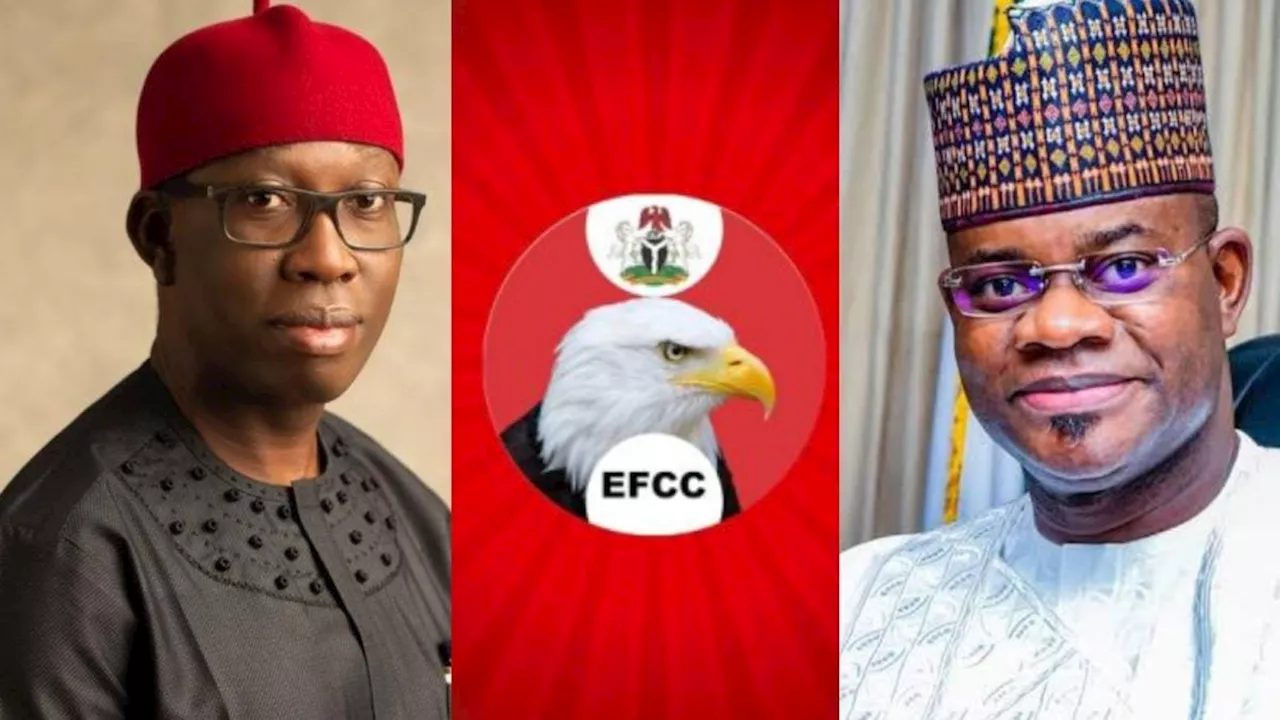
The Human Rights Writers Association of Nigeria (HURIWA) has urged the Economic and Financial Crimes Commission (EFCC) to conclude its investigations involving former Delta State Governor Ifeanyi Okowa and former Kogi State Governor Yahaya Bello, calling for prosecution where sufficient evidence exists.
The group also asked the anti-graft agency to provide a clear update on the status of both cases, stressing that Nigerians deserve transparency in investigations involving allegations of corruption against former public office holders.
Politics Nigeria reports that HURIWA made the demand in a statement signed by its National Coordinator, Emmanuel Onwubiko, on Friday.
The association maintained that the EFCC should either pursue prosecution where the evidence supports criminal charges or explain why further legal action is unwarranted if the available evidence is insufficient.
According to HURIWA, leaving high-profile investigations unresolved for extended periods could undermine public confidence in the fight against corruption.
However, the group emphasised that accountability must go hand in hand with respect for the constitutional presumption of innocence.
HURIWA Demands Update on Okowa’s EFCC Investigation
Okowa, who governed Delta State from 2015 to 2023, was arrested by the EFCC in November 2024 over allegations relating to the management of public funds during his administration.
The investigation reportedly examined approximately N1.3 trillion in 13 per cent derivation funds received from the Federation Account between 2015 and 2023.
The funds form part of Nigeria’s revenue-sharing arrangement for oil-producing states.
Other reported aspects of the investigation included questions about investments and the alleged use of funds to acquire shares in a floating liquefied natural gas project.
At the time of his arrest, the former governor had reportedly visited the EFCC’s Port Harcourt office following an invitation from investigators before he was detained.
The allegations raised questions about the management and use of public resources during his eight-year administration. However, the allegations do not establish criminal liability, and Okowa has denied wrongdoing.
HURIWA said the commission should clarify whether its investigation has produced sufficient evidence to justify prosecution or whether the case requires a different conclusion.
The association argued that Nigerians should not be left uncertain about the progress of investigations involving former governors and substantial sums of public money.
It also stressed that the EFCC should communicate its decisions clearly to prevent prolonged speculation over the status of the case.
Yahaya Bello’s N80.2bn, N110.4bn Cases Under Scrutiny
HURIWA also called for an update on the cases involving Bello, who governed Kogi State from 2016 to 2024.
The former governor has faced separate criminal proceedings over allegations relating to the handling of public funds during his tenure.
In one case, the EFCC filed a 19-count charge against Bello over alleged money laundering involving approximately N80.2 billion.
A separate case concerns allegations of criminal breach of trust involving N110.4 billion, with other individuals also named in the proceedings.
Bello has denied the allegations against him. The charges remain subject to judicial determination and should not be interpreted as proof of guilt.
HURIWA urged the EFCC to pursue the matters through the appropriate legal channels and provide the public with clear information about their status.
The association said the handling of the cases should reflect the principles of transparency, accountability and due process.
It further maintained that neither past public office nor political connections should place anyone beyond lawful scrutiny.
At the same time, HURIWA stressed that accusations alone should not be treated as proof of wrongdoing, adding that the courts must determine the merits of any charges brought against the former governors.
HURIWA Questions APC’s Delta North Senatorial Choice
Beyond the EFCC investigations, HURIWA raised concerns about political parties selecting candidates facing unresolved corruption allegations.
The association specifically called on the All Progressives Congress (APC) to explain the rationale behind its reported senatorial choice in Delta North.
It urged political parties to adopt transparent criteria for selecting candidates for elective positions and to address legitimate public concerns through lawful processes.
HURIWA argued that parties should be prepared to explain their decisions when questions arise about the suitability or eligibility of individuals seeking public office.
However, the group acknowledged that unresolved allegations do not automatically disqualify an individual from contesting an election.
It also called on the Independent National Electoral Commission (INEC) to apply electoral laws impartially, stressing that eligibility questions must be determined in line with the relevant constitutional and statutory provisions.
The association maintained that public accountability and the presumption of innocence should remain central to discussions about candidates facing allegations.
EFCC Urged to Act Without Political Interference
HURIWA reiterated its demand for the EFCC to provide a clear update on the investigations involving Okowa and Bello and take further legal action where the available evidence warrants prosecution.
The group said the commission should avoid allowing politically sensitive investigations to remain indefinitely unresolved.
It also called for both cases to be handled without political interference, insisting that decisions should be based on evidence and the law.
According to HURIWA, Nigerians should not have to choose between protecting the rights of accused persons and demanding accountability from public officials.
The association’s position is that the EFCC should explain the status of both investigations, while any prosecution should proceed through the courts and any determination of guilt should follow due process.
The commission’s current position on the two matters would be necessary to establish whether the investigations remain active, have reached a prosecutorial decision or require further action.