
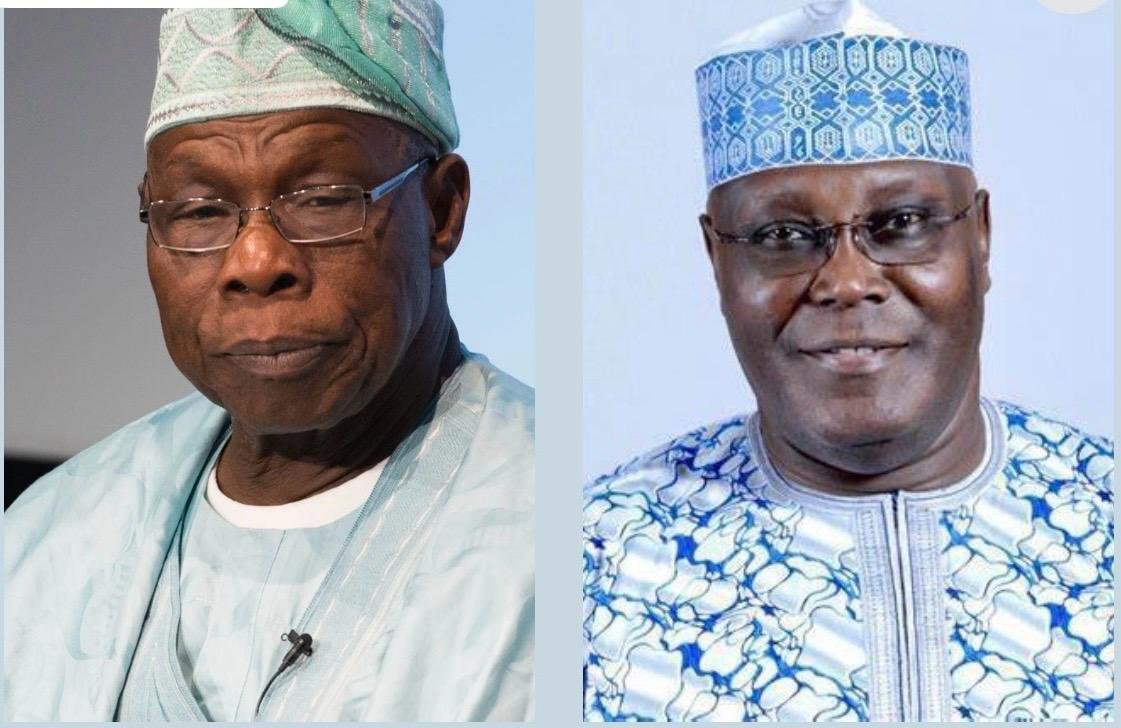
The Presidency has renewed its criticism of former Vice President Atiku Abubakar, sharing a resurfaced video in which former President Olusegun Obasanjo questioned the ADC presidential candidate’s judgment and understanding of the responsibilities of leading Nigeria.
Bayo Onanuga, Special Adviser to President Bola Tinubu on Information and Strategy, shared the 2018 video on his X handle amid escalating political exchanges between the Tinubu administration and Atiku, who is the presidential candidate of the African Democratic Congress (ADC).
In the video, Obasanjo was quoted as expressing doubts about Atiku’s ability to learn what it takes to become president, citing concerns about his judgment and approach to leadership.
“Atiku Abubakar does not have right sense of judgment, and on a number of occasions, I pointed this out to him. He complained too much and wasn’t able to understand or learn what it takes to be a president… so I gave up,” Obasanjo said.
The latest development adds another dimension to the growing political confrontation between the Presidency and Atiku, whose recent criticism of Tinubu has focused on the Federal Government’s economic policies and its 30-day petrol discount initiative.
Atiku Accuses Tinubu of Poorly Copying His Production Subsidy Proposal
The exchange intensified after Atiku accused President Tinubu of adopting his proposed production subsidy policy but failing to implement the essential measures he believes would make it effective.
Speaking at the inauguration of the ADC Presidential Campaign Council at the Shehu Musa Yar’Adua Centre in Abuja, the former vice president described Tinubu as a “dull student” who copied another student’s examination answer without understanding the subject.
“Wait a minute, Bola. You have borrowed the idea but missed the lesson,” Atiku said.
He argued that the President had reduced what he described as a broader production subsidy proposal to a temporary petrol discount, which he maintained would not adequately address the economic challenges confronting Nigerians.
“You had a production subsidy and reduced it to a 30-day gesture,” he stated.
Atiku maintained that he had no objection to the President adopting his proposal but accused the administration of removing the key components that would make the policy effective.
“You copied my production subsidy proposal. There is nothing wrong with that,” he said.
However, he added that the government had stripped away the elements necessary to make the proposal work and replaced them with a temporary discount.
“You stripped away the part that makes it work and handed Nigerians a 30-day discount,” Atiku said.
Questioning the sustainability of the initiative, the ADC candidate asked, “Where is the rest of the answer?”
He concluded his criticism by telling the President, “Bola, please, you see why it is good to go to school?”
Presidency Defends 30-Day Petrol Discount
The Presidency has defended the petrol discount arrangement, insisting that it should not be confused with the petroleum subsidy system abolished by the Tinubu administration in May 2023.
Onanuga previously explained that the initiative involved Nigerian National Petroleum Company Limited (NNPC) retail outlets reducing or foregoing their profit margins for a specified period and transferring the resulting savings to customers.
According to him, the arrangement differs fundamentally from the former petrol subsidy system, under which the government paid part of the cost of fuel on behalf of consumers.
“Every marketer adds a margin to the price it pays for the fuel it sells. A margin discount means the retailer chooses to take a smaller margin, or no margin at all for a period, and passes the saving to the customer. The cost of the discount is borne by the retailer alone,” Onanuga explained.
He said the arrangement did not involve the government using public funds to subsidise petrol prices.
“A subsidy is different. It is when government pays part of the price the consumer would otherwise pay. That money comes from public revenue — funds that would otherwise go to salaries, schools, hospitals and infrastructure,” he stated.
“That is the regime this administration ended in 2023, and it is not coming back,” Onanuga added.
The clarification represents the Presidency’s defence of the initiative against criticism from opposition figures who argue that a temporary price reduction does not offer a lasting solution to Nigeria’s cost-of-living crisis.
Atiku Describes Petrol Discount as Publicity Stunt
Atiku had earlier criticised the 30-day petrol discount, describing it as a “panic-driven publicity stunt”.
He argued that a short-term intervention would not adequately address the economic hardship Nigerians have experienced following the removal of the petrol subsidy.
The former vice president’s position is that the government should adopt more comprehensive economic measures rather than rely on a temporary discount at selected fuel stations.
The dispute has therefore expanded beyond the immediate price reduction to a broader disagreement over how best to address fuel costs, household spending pressures and the wider economic challenges facing the country.
ADC Campaign Council and NDC Also Criticise Initiative
The ADC Presidential Campaign Council has also questioned the effectiveness of the petrol discount, arguing that the measure may not provide meaningful relief to households struggling with rising living costs.
The Nigeria Democratic Congress (NDC) similarly rejected the arrangement, describing it as “tokenism and a Greek gift”.
The party questioned why the discount was limited to NNPC retail outlets, warning that concentrating demand at selected stations could result in long queues, congestion and potential safety concerns.
These criticisms reflect opposition parties’ wider concerns about the scope, duration and practical impact of the initiative.
Political Tensions Mount Ahead of 2027 Election
The latest exchange highlights the growing confrontation between Tinubu and Atiku as political competition builds ahead of the 2027 presidential election.
While the Presidency has sought to defend the administration’s economic decisions and challenge Atiku’s leadership credentials, the ADC candidate has continued to question the effectiveness of government policies and present alternative approaches to tackling Nigeria’s economic difficulties.
The resurfaced Obasanjo video has added a personal and historical dimension to the dispute, bringing past criticism of Atiku back into the current political conversation.
At the centre of the disagreement are two competing narratives: the Presidency’s defence of its petrol pricing initiative and Atiku’s argument that temporary relief measures are insufficient without a more comprehensive economic strategy.
As political exchanges intensify, the effectiveness of the 30-day petrol discount and the broader debate over fuel pricing and economic relief are likely to remain prominent issues in Nigeria’s political discourse.