
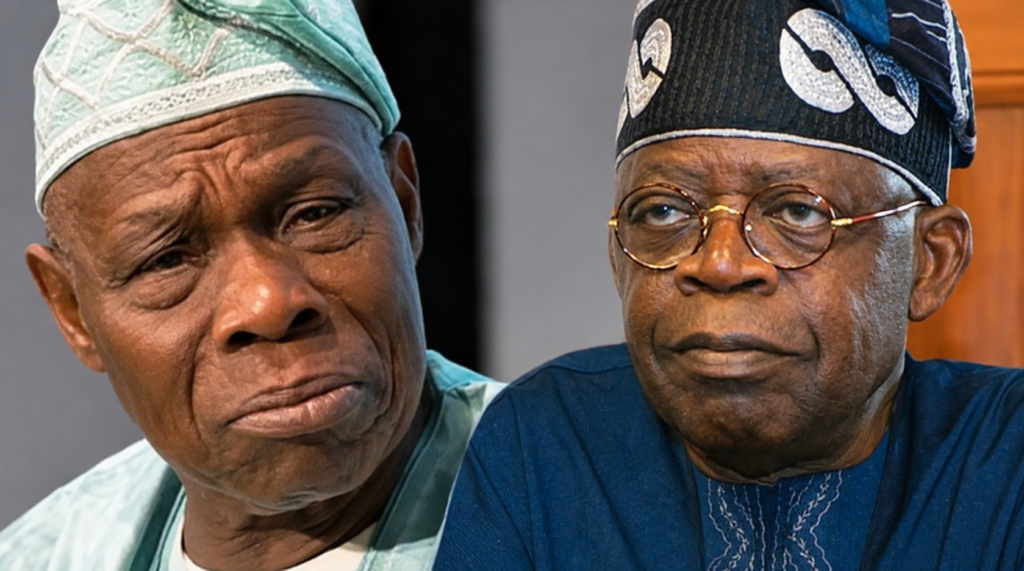
Former President Olusegun Obasanjo has criticised President Bola Ahmed Tinubu over the handling of fuel subsidy removal, saying a prepared leader would not announce the policy before making adequate arrangements to cushion its effects on Nigerians.
Obasanjo made the remarks during an interview with News Central Television, where he questioned the government’s approach to economic reforms and its response to the hardship experienced by citizens.
According to the former Nigerian leader, responsible leadership requires careful planning, an understanding of the consequences of major policy decisions and adequate preparation to protect vulnerable citizens.
He argued that a president should consider the impact of a policy before implementing it rather than introducing relief measures months after Nigerians have started experiencing its consequences.
“A serious leader studies the shock before he acts. He stocks buffers. He phases the pain so that ordinary people do not suffer at once.
“A prepared president does not announce ‘Subsidy is gone’ on day one and invent palliatives months later,” Obasanjo said.
Obasanjo Questions Tinubu’s Three-Point Agenda
The former president also questioned the three-point agenda of the Tinubu administration, asking who designed the programme and what it was intended to achieve.
He expressed concerns about the government’s policy direction, suggesting that the difficulties Nigerians have experienced since Tinubu assumed office highlight the importance of adequate preparation before taking major economic decisions.
Obasanjo specifically pointed to the rising cost of food, transportation and fuel as areas where Nigerians have continued to feel the impact of economic hardship.
He maintained that the pressure experienced by households and businesses should prompt serious questions about the planning and implementation of government policies.
Obasanjo Speaks on 2027 Elections
Obasanjo also urged Nigerians to reflect carefully before deciding who to support in the 2027 general elections.
He stressed that the country’s future depends significantly on the choices voters make, adding that leadership should be judged by its ability to plan, prepare and protect citizens rather than by political slogans.
According to him, effective governance requires leaders to anticipate challenges, develop practical solutions and ensure that citizens are not left to bear the full burden of sudden policy decisions.
His comments add to the ongoing public debate over the economic reforms introduced by the Tinubu administration, particularly fuel subsidy removal and the measures adopted to address its effects on Nigerians.
As political discussions ahead of the 2027 elections continue, Obasanjo’s remarks have brought renewed attention to questions surrounding economic planning, leadership accountability and the welfare of ordinary Nigerians.