
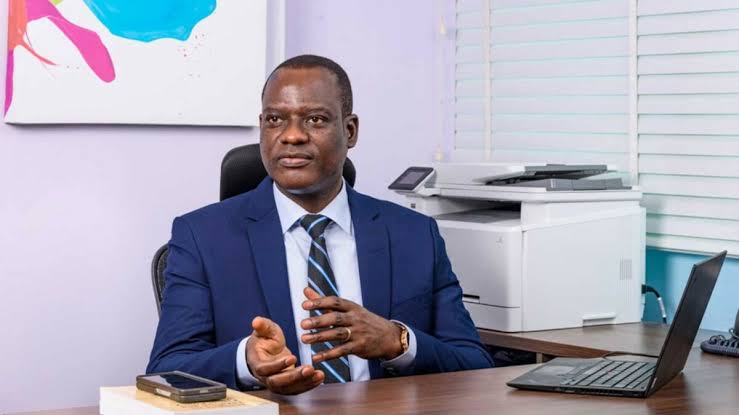
The African Democratic Congress (ADC) National Publicity Secretary, Bolaji Abdullahi, has questioned whether Finance Minister Taiwo Oyedele has the appropriate educational background to oversee Nigeria’s economic policies, particularly the Federal Government’s approach to petrol subsidy.
Abdullahi made the remarks on Monday during an interview on Channels Television’s Politics Today, where he discussed the government’s economic decisions and the ideological considerations surrounding subsidy policies.
While acknowledging Oyedele’s intelligence and competence, the ADC spokesman argued that managing a national economy requires specialised training and a deeper understanding of economic principles.
“I’m not saying he’s incompetent, but I think he doesn’t have the right education,” Abdullahi said.
He explained that different professional backgrounds could influence how individuals assess economic challenges, particularly the differences between accounting, classical economics and development economics.
“The way an accountant reviews an economy is not the same way an economist reviews it. And the same way a classical economist would look at it is not the way a development economist would look at it,” he stated.
Abdullahi added that Nigeria needed professionals with the appropriate training to formulate and implement economic policies.
“We need people who are trained to do this job to do it,” he said.
Taiwo Oyedele’s Educational Background and Career
Oyedele previously served as chairman of the Presidential Committee on Fiscal Policy and Tax Reforms before his appointment as Minister of State for Finance. He was subsequently appointed Minister of Finance and Coordinating Minister of the Economy.
He obtained a Higher National Diploma in Accountancy and Finance from Yaba College of Technology before earning a Bachelor of Science degree in Applied Accounting from Oxford Brookes University.
Oyedele also completed executive education programmes at the London School of Economics, Yale University, the Gordon Institute of Business Science and Harvard Kennedy School.
Before joining the Federal Government, he spent 22 years at PricewaterhouseCoopers (PwC), where he joined in 2001 and rose to become Fiscal Policy Partner and Africa Tax Leader.
His professional experience in taxation and fiscal policy played a prominent role in his work on the presidential tax reform committee.
Petrol Discount Policy Sparks Debate Over Subsidy
Abdullahi’s comments come amid public debate over the Federal Government’s proposed 30-day petrol discount at Nigerian National Petroleum Company Limited (NNPC) filling stations.
According to a disclosure by Oyedele last Thursday, the initiative would provide a discount on petrol, with public transport operators receiving priority under the arrangement.
Oyedele described the measure as a margin discount at NNPC stations, insisting that it did not represent a return to petrol subsidy.
However, the proposal has attracted criticism from several political groups and figures, including former Vice President Atiku Abubakar, the Obidient Movement, the Nigeria Democratic Congress and the presidential campaign organisation of Oyo State Governor Seyi Makinde.
The critics reportedly rejected the proposed intervention, describing it as inadequate and politically motivated.
The disagreement highlights continuing divisions over how the Federal Government should respond to petrol prices and the wider economic pressures facing Nigerians.
Abdullahi’s remarks have also brought renewed attention to the qualifications and professional expertise required to manage Nigeria’s economy, as debate over the government’s fiscal and energy policies continues.