
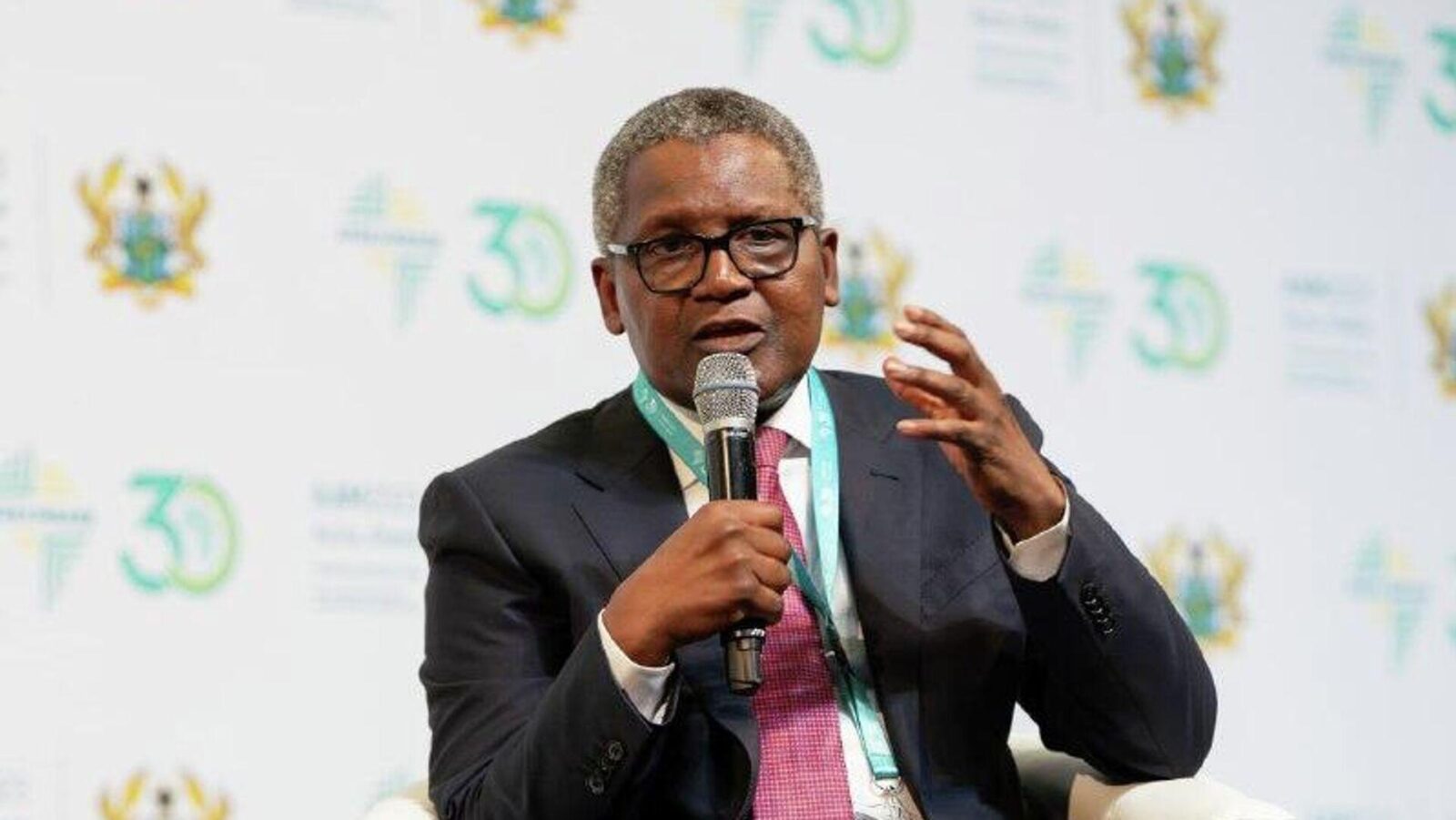
Nigerian billionaire businessman Aliko Dangote has raised concerns over the growing debt burden facing the country’s oil and gas industry, revealing that a few domestic companies owe local banks approximately $7 billion.
Dangote warned that the outstanding debt is already affecting access to financing across the industry, with most domestic bank funding for oil and gas operations reportedly on hold.
Speaking at the Nigerian Association of Petroleum Explorationists conference in Lagos on Wednesday, Dangote said the financial exposure of local banks to oil and gas companies was creating broader challenges for operators seeking capital to expand production and exploration activities.
“A few companies, I believe, owe the banks about $7bn,” Dangote said. “As a result, most funding from our domestic banks is on hold.”
He did not identify the companies involved, provide a breakdown of their borrowing or disclose how much of the debt was overdue.
Dangote Raises Concerns Over Nigeria’s Oil Industry Financing
The reported $7 billion debt exposure highlights the financing challenges confronting Nigeria’s oil and gas sector, particularly as the government seeks to increase domestic crude production and attract fresh investment.
According to Dangote, the reluctance of local banks to extend additional credit could make it harder for Nigerian-owned oil companies to finance exploration, develop oil assets and increase production.
He urged domestic financial institutions to provide more support to indigenous operators rather than forcing them to depend heavily on foreign financing.
Dangote also called for greater policy consistency, arguing that fewer unexpected regulatory and government policy changes would help create a more predictable investment environment.
He stressed the importance of expanding exploration activities and strengthening local technical expertise to improve Nigeria’s oil production capacity.
Nigeria’s 3 Million Barrels Per Day Production Target Faces Challenges
Nigeria is targeting crude oil production of 3 million barrels per day by 2030 as part of its ambition to strengthen the petroleum sector and increase government revenue.
However, the country’s current production levels remain significantly below that ambition.
The latest figures released on Wednesday showed that Nigeria produced approximately 1.51 million barrels per day in October, compared with 1.53 million barrels per day in September.
Although the October output was slightly lower, it was sufficient for Nigeria to meet its 1.5 million barrels per day OPEC production quota.
The country has now met its OPEC quota for six consecutive months.
Dangote, however, believes the government’s 3 million barrels per day target is not ambitious enough.
He recalled that Nigeria previously pursued a much higher production target of 4.2 million barrels per day by 2024, an ambition the country failed to achieve as actual output remained far below the projected level.
Nigeria Offers 40 Oil Blocks to Attract Exploration Investment
In a move to increase exploration and production activities, the Nigerian Upstream Petroleum Regulatory Commission (NUPRC) is offering 40 oil and gas blocks under its 2026 licensing round.
The regulator said last month that 22 recent awardees were expected to contribute at least 250,000 barrels per day of additional production within five years.
The licensing initiative is expected to attract investment into Nigeria’s upstream petroleum industry and encourage the development of new oil and gas assets.
However, the funding challenges highlighted by Dangote raise questions about whether local operators will have sufficient access to capital to take advantage of emerging exploration opportunities.
Dangote Refinery’s Debt Stands at N7.9 Trillion
Dangote’s comments on the industry’s debt exposure come as his own 650,000-barrel-per-day refinery near Lagos continues to manage a substantial debt burden.
The refinery had outstanding debt of N7.9 trillion, equivalent to approximately $5.8 billion, at the end of June.
However, it reduced its debt balance by N798 billion during the first half of the year.
The refinery has also attracted significant investor interest following its recent share offering, which received applications worth N5.85 trillion from nearly 3.8 million investors.
Dangote did not clarify whether the refinery’s borrowing was included in the approximately $7 billion debt exposure attributed to Nigerian oil and gas companies.
What the $7 Billion Debt Means for Nigeria’s Oil Industry
The reported debt exposure could have significant implications for Nigeria’s ambition to increase crude oil production, particularly if domestic banks continue restricting lending to the sector.
Oil exploration, field development and production expansion require substantial long-term financing. Limited access to local credit could therefore slow investment, delay projects and increase dependence on international lenders.
For indigenous operators, the situation could also make it more difficult to compete for oil assets and meet the financial requirements associated with new licensing opportunities.
As Nigeria pursues its 2030 production ambitions, improving access to financing, strengthening investor confidence and maintaining consistent petroleum policies will remain critical to the industry’s growth.
The key question is whether Nigerian banks can restore confidence in oil and gas lending while managing their existing exposure to the sector.