
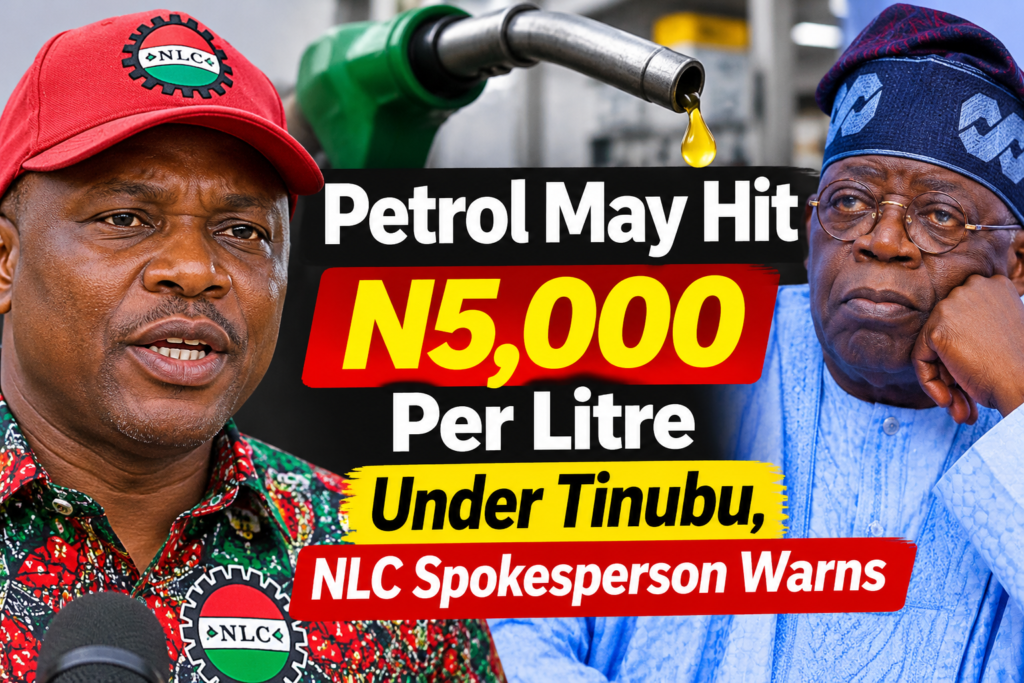
The Nigeria Labour Congress (NLC) has warned that Nigerians could end up paying as much as N5,000 per litre for petrol if the current government’s policies continue, amid growing concerns over rising fuel prices across the country.
Benson Upah, spokesperson for the NLC, raised the concern during an interview with Weekend Trust, where he criticised the recent increase in the pump price of Premium Motor Spirit (PMS), popularly known as petrol.
Upah described the latest fuel price adjustment as a breach of the agreement between the organised labour movement and President Bola Tinubu’s administration.
According to him, the Federal Government’s position on petrol subsidy removal has raised questions, particularly regarding the claim that the subsidy was never restored.
The NLC spokesperson questioned the justification for the significant increase in petrol prices, recalling that the product previously sold for approximately N650 per litre before rising to N1,500 or N2,000 in some instances.
He warned that Nigerians might not have witnessed the end of fuel price increases, adding that petrol could eventually sell for nothing less than N5,000 per litre if government policies continue along the current trajectory.
“Subsidy was never restored at any point in time as they claimed,” Upah said.
He further questioned what could justify moving the pump price of petrol from N650 to N1,500 or N2,000 per litre.
“I want to tell you something, what this signals is that Nigerians have not seen the end yet, we may end up paying nothing less than N5,000 per liter for fuel in this country. We hope not to get there but if we get there, the decision will be left to Nigerians,” he stated.
Upah stressed that the N5,000 projection was a warning about the possible consequences of government policies rather than a confirmed future price.
His comments come amid continued public concerns about the affordability of petrol, transportation costs and the wider economic impact of fuel price increases.
The NLC has consistently raised concerns about the effects of rising petroleum prices on Nigerian workers and households, particularly as higher energy costs affect the prices of goods and essential services.
The latest warning is likely to renew discussions about the Federal Government’s fuel pricing policies, its relationship with organised labour and the economic burden facing Nigerians.