
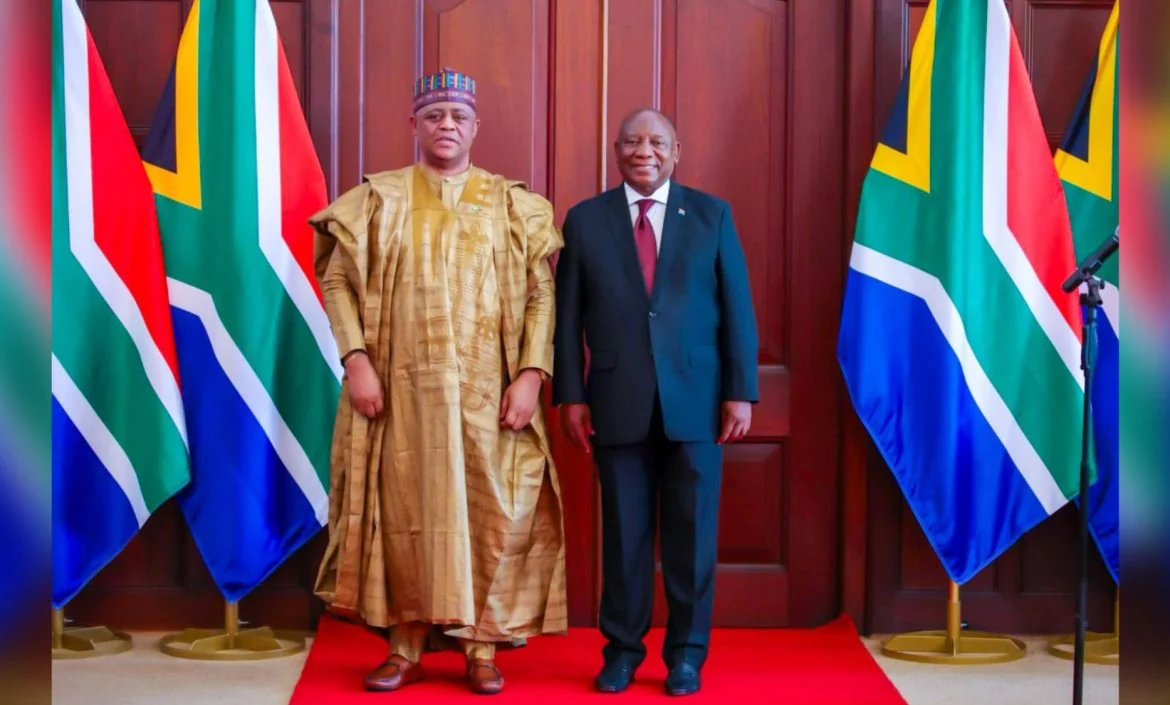
South Africa’s Department of International Relations and Cooperation (DIRCO) confirmed that its Director-General, Zane Dangor, met with Fani-Kayode on Tuesday, November 17, to formally communicate the government’s concerns over the incident and the Nigerian envoy’s subsequent social media comments.
The meeting, described diplomatically as a demarche, followed Fani-Kayode’s public complaint that Nigeria’s delegation was deliberately excluded from the broadcast of a ceremony where ambassadors from 15 countries presented their letters of credence to President Ramaphosa.
In a statement issued after the meeting, DIRCO said Dangor expressed South Africa’s concerns about the events surrounding the presentation of the Nigerian High Commissioner’s credentials and his subsequent remarks on social media.
“The Director-General conveyed South Africa’s concern regarding events that transpired following the presentation of the High Commissioner’s Letters of Credence to His Excellency President Cyril Ramaphosa, as well as subsequent remarks made on social media,” the statement read.
South Africa Cites Vienna Convention Against Fani-Kayode
During the meeting, the South African government reminded Fani-Kayode of the diplomatic obligations governing foreign representatives in their host countries.
According to DIRCO, Dangor specifically referred the Nigerian envoy to Article 41 of the 1961 Vienna Convention on Diplomatic Relations.
The provision requires diplomatic agents to respect the laws and regulations of their host countries and conduct official business through appropriate diplomatic channels.
“In this regard, it was emphasised that all official communication should be conducted through established diplomatic channels, including DIRCO,” the statement added.
How the Dispute Started
The diplomatic disagreement began after Fani-Kayode complained that his introduction and speech were missing from the official livestream of the credentials presentation ceremony held in Pretoria.
The Nigerian envoy had presented his letters of credence to President Ramaphosa at the South African Presidential Guest House alongside representatives of 14 other countries.
Fani-Kayode described the occasion as historic, noting that it marked the arrival of a substantive Nigerian ambassador to South Africa after four years without one.
However, he expressed disappointment after discovering that Nigeria’s segment was not included in the livestream.
According to him, all 15 ambassadors were introduced and given opportunities to deliver speeches, but Nigeria was the only country whose presentation was not broadcast.
He alleged that the livestream went off when the Nigerian delegation was being introduced and resumed only after he had delivered his address.
Fani-Kayode also claimed that he personally raised the matter with Ramaphosa during a photograph session at the venue.
According to the former Nigerian Minister of Aviation, the South African President responded by taking him to relevant officials and directing them to address his complaint.
Fani-Kayode Accuses South African Officials of Excluding Nigeria
Following the incident, Fani-Kayode took to social media to express his displeasure, suggesting that some elements in South Africa were unwilling to hear or see Nigeria’s representatives.
“Clearly some elements in South Africa do not want to hear what we have to say or see our faces, but we are here to stay as long as we are welcome and have the confidence of President Ramaphosa, which I am sure we do,” he wrote.
He also disclosed that he declined an interview request from the South African Broadcasting Corporation (SABC) while at the venue because of what he described as the unacceptable treatment of the Nigerian delegation.
Ramaphosa’s Spokesperson Rejects Fani-Kayode’s Account
The controversy subsequently attracted a response from Vincent Magwenya, spokesperson for President Ramaphosa, who rejected Fani-Kayode’s account of the South African President’s involvement.
Magwenya explained that Ramaphosa had no authority to interfere in the operational activities or editorial decisions of the country’s public broadcaster.
He said the President merely directed Fani-Kayode to Sophie Mokoena, whom he identified as the appropriate official to address the complaint.
“Your Excellency, I deeply regret that I have to address you through a public platform. However, now that you have falsely referenced the President on a matter he has no involvement in, I’m duty-bound to clarify your misrepresentation of facts,” Magwenya wrote.
He further maintained that Ramaphosa did not intervene on the Nigerian envoy’s behalf, describing the issue as an operational matter that should have been handled through the appropriate channels.
“Frankly, your approach in this regard on a minor operational issue which you misunderstood was grossly inappropriate,” he added.
Nigerian High Commission Defends Fani-Kayode
The Nigerian High Commission subsequently defended Fani-Kayode, accusing the South African presidential spokesperson of making provocative comments and attempting to escalate the disagreement.
The commission maintained that the Nigerian envoy had been treated with contempt and insisted that Ramaphosa had intervened appropriately.
SABC Explains Its Coverage of the Ceremony
The South African Broadcasting Corporation also responded to the controversy, maintaining that it covered the diplomatic ceremony through its SABC News LIVE channel on SABC+.
The broadcaster said Fani-Kayode’s arrival was shown during a live broadcast on its DStv channel. It also disclosed that it had published a video showing the Nigerian envoy speaking with President Ramaphosa.
However, the SABC clarified that its editorial coverage and the South African Presidency’s livestream arrangements were separate matters.
The diplomatic disagreement has since drawn attention to the importance of established communication channels and diplomatic protocol in relations between Nigeria and South Africa.