
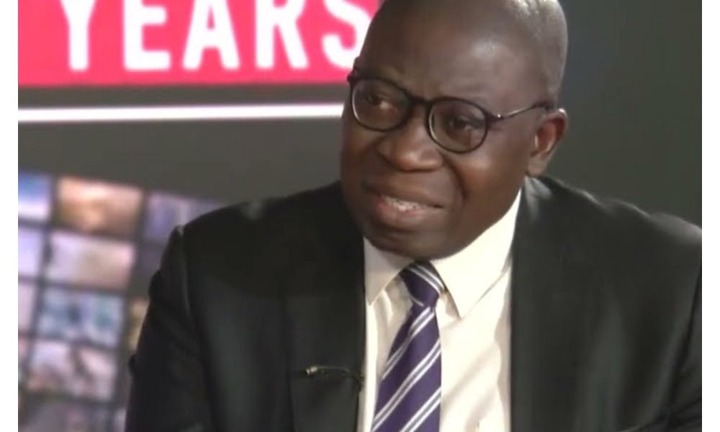
The Nigeria Democratic Congress (NDC) risks being left without a candidate for the Delta Central Senatorial District in the 2027 general elections following the Federal High Court judgment nullifying Senator Ovie Omo-Agege’s nomination, according to Arise News Politics Editor, Sumner Sambo.
Sambo raised the concern while analysing the legal controversy surrounding Omo-Agege’s disqualification by the Federal High Court sitting in Warri, Delta State, noting that the party’s ability to field a candidate for the senatorial seat may now depend on the outcome of the former Deputy Senate President’s appeal.
Justice Hyeladzira Ajiya Nganjiwa had on Tuesday nullified Omo-Agege’s nomination as the NDC senatorial candidate following a suit filed by Professor Alexander Osondu Akpodiete.
The court ruled that the NDC failed to comply with provisions of the Electoral Act requiring political parties to submit their membership registers to the Independent National Electoral Commission (INEC) at least 21 days before conducting their primary elections.
The judge also found that Omo-Agege’s name was missing from the membership register submitted to INEC within the stipulated period.
Another issue considered by the court was evidence that the former Delta Central senator participated in the All Progressives Congress (APC) senatorial primary held on May 18, 2026, suggesting that he was still a member of the party at the time.
Consequently, the court directed INEC to remove Omo-Agege’s name from the list of candidates and restrained him from presenting himself as the NDC candidate.
The court also held that the statutory deadline for conducting fresh primaries to produce a replacement candidate had elapsed, raising concerns about the NDC’s options ahead of the 2027 elections.
Omo-Agege to Challenge Disqualification at Court of Appeal
Reacting to the judgment, Sambo disclosed that Omo-Agege’s legal team had indicated its intention to challenge the ruling at the Court of Appeal on two grounds.
According to him, the former Deputy Senate President’s camp argued that both the NDC and INEC presented membership registers containing Omo-Agege’s name during the court proceedings.
He questioned why the trial judge proceeded to nullify the nomination despite the alleged documentary evidence.
Sambo said: “It’s going to be a very difficult situation ahead. Because look at some of the issues that are being raised. I mean, they are saying that the judge did not get all the facts right. They are going on appeal right now.
“His spokesman just sent out a statement not long ago, saying that they are going on appeal on two grounds. That both the NDC and INEC presented a register that showed that Omo-Agege’s name was there.
“And so, on what grounds did the judge, I mean Justice Nganjiwa, go ahead and nullify?”
Omo-Agege has rejected the Federal High Court’s decision and directed his lawyers to challenge the judgment, maintaining that some of the court’s findings were inconsistent with the documentary evidence presented during the proceedings.
Sambo Questions Omo-Agege’s Participation in APC and NDC Primaries
Beyond the membership register controversy, the Arise News editor questioned the circumstances surrounding Omo-Agege’s movement from the APC to the NDC.
He observed that the former senator reportedly participated in the APC Delta Central senatorial primary on May 18, 2026, before subsequently taking part in the NDC primary on May 28.
Sambo said the development raised questions about when Omo-Agege formally resigned from the APC and became a member of the NDC.
He noted that the Electoral Act prohibits aspirants from participating in the primary elections of two political parties for the same elective position.
According to him, the circumstances surrounding Omo-Agege’s participation in both exercises could become an important issue in the ongoing legal dispute.
He said: “But then you can’t take part in two party primaries at the same time, which is what happened because Omo-Agege was seen at the APC senatorial primary election. So, at what point in time did he then go ahead to take part in that of the NDC?”
Sambo further explained that the restriction against participating in multiple party primaries was contained in the 2022 Electoral Act.
“Since the 2022 Electoral Act, you can’t participate in two party primaries in the same election. So these are some of the issues,” he added.
NDC Membership Register Raises Further Questions
Sambo also questioned whether the NDC properly complied with the legal requirement to submit its membership register to INEC at least 21 days before conducting its senatorial primary.
He noted that the controversy surrounding Omo-Agege’s nomination involved not only whether his name appeared on the register but also whether his alleged defection from the APC to the NDC was formally communicated to the appropriate authorities before the party primary.
The questions, he suggested, would need to be addressed as the legal battle progresses.
The membership register requirement is among the statutory provisions governing political party primaries and candidate nominations, making compliance an important consideration in determining the validity of party nominations.
Akpodiete’s Legal Standing Also Comes Under Scrutiny
The Arise News editor also examined the argument reportedly raised by Akpodiete, who instituted the suit challenging Omo-Agege’s nomination.
The plaintiff was said to have maintained that he lacked the necessary standing to challenge the primary election because he was not among those screened and accredited to participate in the exercise.
However, Sambo explained that Akpodiete did not ask the court to declare him the winner of the NDC primary.
Rather, his case was reportedly centred on establishing that Omo-Agege was not qualified to emerge as the party’s senatorial candidate.
Sambo said the argument raised another question about the legal implications of disqualifying Omo-Agege, particularly who should have been declared the party’s candidate if the former senator was found ineligible.
The issue adds another dimension to the dispute, which now involves questions about party membership, compliance with electoral laws, participation in multiple primaries and the legal standing of the plaintiff.
Sambo Calls on INEC to Clarify Its Role
Amid the controversy, Sambo urged politicians to comply strictly with the Electoral Act and INEC guidelines when participating in party primaries and seeking elective positions.
He also called on INEC to clarify whether its officials monitored Omo-Agege’s participation in both the APC and NDC senatorial primaries.
According to him, the electoral commission should explain whether it was aware of the former senator’s participation in the two exercises and whether any relevant information was presented before the Federal High Court.
He said: “But politicians should always adhere to the rulebook, and the rulebook here is not just the Electoral Act, but of course, INEC guidelines.
“And INEC needs to also tell us: Did they monitor the election? Where Senator Omo-Agege took part in the APC Delta Central Senatorial Primary Election, and that of the NDC too? And if they saw him in both primary elections, did they make that available to the judge?”
The call places additional attention on INEC’s role in monitoring party primaries and ensuring compliance with electoral regulations.
NDC’s 2027 Delta Central Candidacy Hangs on Appeal
With the Federal High Court having nullified Omo-Agege’s nomination and the statutory deadline for fresh primaries reportedly expired, the NDC faces uncertainty over its representation in the Delta Central Senatorial District for the 2027 general elections.
The party’s immediate options will be influenced by the legal proceedings at the Court of Appeal and any consequential decisions arising from the challenge.
Sambo maintained that the outcome of Omo-Agege’s appeal could determine whether the former Deputy Senate President remains eligible to contest under the NDC platform or whether the party will be left without a candidate for the senatorial seat.
The case has also brought renewed attention to compliance with electoral laws, party membership registration, defections and the conduct of multiple party primaries ahead of Nigeria’s 2027 general elections.