
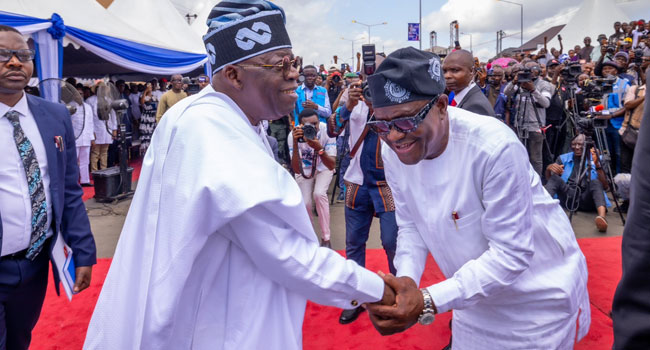
As Nigeria moves closer to the 2027 general elections, political activities are intensifying across the country, with politicians and political parties already positioning themselves for the contest.
One of the figures attracting considerable attention is the Minister of the Federal Capital Territory (FCT), Nyesom Wike, whose political activities have increasingly placed him at the centre of the 2027 debate.
Wike, a former governor of Rivers State and a prominent member of the Peoples Democratic Party (PDP), has openly declared his support for President Bola Tinubu’s re-election bid while insisting that his support for the President does not amount to an endorsement of all All Progressives Congress (APC) candidates.
The position has become a source of disagreement between Wike and some APC governors, particularly over the role of his proposed Rainbow Coalition and how it fits into the ruling party’s political structure.
Wike’s Rainbow Coalition and Tinubu’s 2027 Bid
Wike has described the Rainbow Coalition as a multi-party platform designed to mobilise support for President Tinubu’s re-election in 2027.
According to the minister, the coalition is separate from the APC and is not intended to prevent other political parties from fielding candidates for governorship, National Assembly and State House of Assembly elections.
Wike reiterated this position in September 2026, saying his political focus was on mobilising support for Tinubu at the presidential level while parties remained free to contest other elections.
The clarification came after the Progressive Governors’ Forum expressed concern about political arrangements that could create parallel structures or weaken the APC and its candidates.
APC governors have maintained that they remain committed to the party and its political structure.
The disagreement has subsequently become more public, with Wike accusing some APC governors of opposing his coalition and describing them as “politically lazy.” The governors, however, have continued to distance themselves from the Rainbow Coalition.
Wike has also alleged that opposition from some governors is connected to political interests surrounding the future leadership of the National Assembly. Those claims are Wike’s own allegations and have been reported as such.
Wike’s Claim Over Rivers and FCT Political Structures
The central question surrounding Wike’s 2027 strategy is the extent of his political influence, particularly in Rivers State and the FCT.
On September 2, 2026, Wike declared that he remained in control of political structures in Rivers State and the FCT.
Speaking in Port Harcourt, the former Rivers governor described himself as the “General Commander of the Political Infantry” and said he intended to deliver Rivers and the FCT to President Tinubu in the 2027 presidential election.
The claim, however, remains a political assertion rather than an independently measurable indicator of how voters will behave in 2027.
Election outcomes depend on several factors, including candidates, party structures, voter turnout, campaign organisation and the conduct of voters at polling units.
That distinction is particularly important because political influence at the elite level does not necessarily translate directly into votes.
The 2023 Rivers Presidential Election
The 2023 presidential election provides an important reference point for assessing the political landscape in Rivers State.
According to the official results published by the Independent National Electoral Commission (INEC), Bola Tinubu received 231,591 votes in Rivers State, Peter Obi received 175,071, while Atiku Abubakar polled 88,468 votes.
Nationally, Tinubu was declared elected with 8,794,726 votes, followed by Atiku with 6,984,520 and Obi with 6,101,533.
The Rivers result has since featured prominently in arguments over Wike’s political influence.
Supporters of Wike point to his political network and his role as governor at the time, while his critics argue that the result cannot by itself establish that he controls the voting decisions of Rivers residents.
Ultimately, the 2027 election will provide a new electoral test, rather than simply repeating the circumstances of 2023.
The G5, Atiku and Wike’s Political Journey
To understand Wike’s current relationship with Tinubu, it is necessary to revisit the political crisis that unfolded within the PDP ahead of the 2023 presidential election.
After Atiku Abubakar emerged as the PDP presidential candidate in May 2022, Wike and four other PDP governors formed the group popularly known as the G5 or Integrity Group.
The group comprised Wike of Rivers, Seyi Makinde of Oyo, Samuel Ortom of Benue, Ifeanyi Ugwuanyi of Enugu and Okezie Ikpeazu of Abia.
At the centre of the dispute was the continued leadership of Iyorchia Ayu as PDP national chairman.
The G5 demanded Ayu’s resignation, arguing that having both the presidential candidate and the national chairman from the North was inconsistent with the party’s principle of regional balance.
The disagreement contributed to Wike and his allies withdrawing from Atiku’s presidential campaign activities.
Although the five governors did not formally adopt a single alternative presidential candidate, Wike’s political activities during the campaign were widely associated with opposition to Atiku’s candidacy.
From PDP Power Broker to Tinubu’s Minister
Following the 2023 election, President Bola Tinubu appointed Wike as Minister of the Federal Capital Territory.
Tinubu announced Wike’s FCT portfolio on August 16, 2023, and Wike was subsequently sworn into office alongside other members of the Federal Executive Council.
The appointment was politically significant because Wike remained a member of the PDP while serving in an administration led by the APC.
His continued relationship with the Tinubu administration has since evolved into an increasingly open political partnership ahead of 2027.
By 2026, Wike was no longer merely defending his decision to work with the Tinubu administration. He was actively promoting a cross-party coalition aimed at supporting Tinubu’s re-election.
How Much Political Influence Does Wike Have?
Wike’s political influence is difficult to quantify.
There is no single electoral measurement that can establish how many votes a particular politician can personally deliver. Political leaders may possess networks, loyal supporters and organisational structures, but voters ultimately cast individual ballots.
Wike’s own position is that he retains significant influence in Rivers State and the FCT. His September 2026 declaration that he remains in charge of political structures in both territories reflects his assessment of his political standing.
At the same time, the opposition from some APC governors demonstrates that his influence does not automatically extend to the entire ruling party structure.
The disagreement between Wike and the APC Governors’ Forum therefore highlights an important distinction between a political coalition built around an individual and the formal structures of a political party.
Opposition Questions Wike’s Influence
Wike’s political influence has also come under criticism from opposition figures.
Speaking to Naija News, South-South coordinator of the Obidient Movement, Onochie Osheokwu, rejected the suggestion that Wike commands decisive political influence across the region.
Osheokwu argued that voters in the South-South are increasingly politically conscious and that the circumstances surrounding the 2023 election cannot simply be replicated in 2027.
He also claimed that the Obidient Movement is better organised than it was during the 2023 election and would challenge Wike’s political structure in Rivers State.
However, those comments represent the position of an opposition political actor and should be understood as political commentary rather than an independent measurement of Wike’s electoral strength.
What the Rainbow Coalition Means for 2027
The dispute over the Rainbow Coalition reflects a wider question about how presidential and down-ballot politics will interact in 2027.
Wike’s stated position is that politicians and political parties can support Tinubu for president while contesting against one another in governorship and legislative elections.
The APC Governors’ Forum, however, has emphasised the importance of maintaining the party’s political structure and protecting the interests of APC candidates.
This creates a potentially complicated political arrangement in which individuals from different parties could support the same presidential candidate while competing against one another in other elections.
Wike has insisted that this is precisely what his Rainbow Coalition is designed to facilitate.
The Bigger Question Ahead of 2027
The most important test for Wike’s strategy will ultimately come at the ballot box.
His political history demonstrates that he has been an influential figure within the PDP, played a prominent role in the G5 crisis and subsequently became a senior member of the Tinubu administration.
His current strategy, however, goes beyond his personal political relationship with Tinubu.
By promoting the Rainbow Coalition, Wike is attempting to build a cross-party network around the President’s 2027 re-election while maintaining that individual parties should remain free to pursue their own candidates in other elections.
Whether that structure can coexist with the APC’s established campaign machinery remains one of the emerging political questions ahead of the 2027 elections.
For now, Wike’s position is clear: he says his priority is mobilising support for Tinubu, while the APC governors insist that the party’s own structures and candidates must remain central to the election.
The eventual strength of both approaches will be determined by the political organisation, candidates, campaigns and voters that emerge as the 2027 election approaches.