
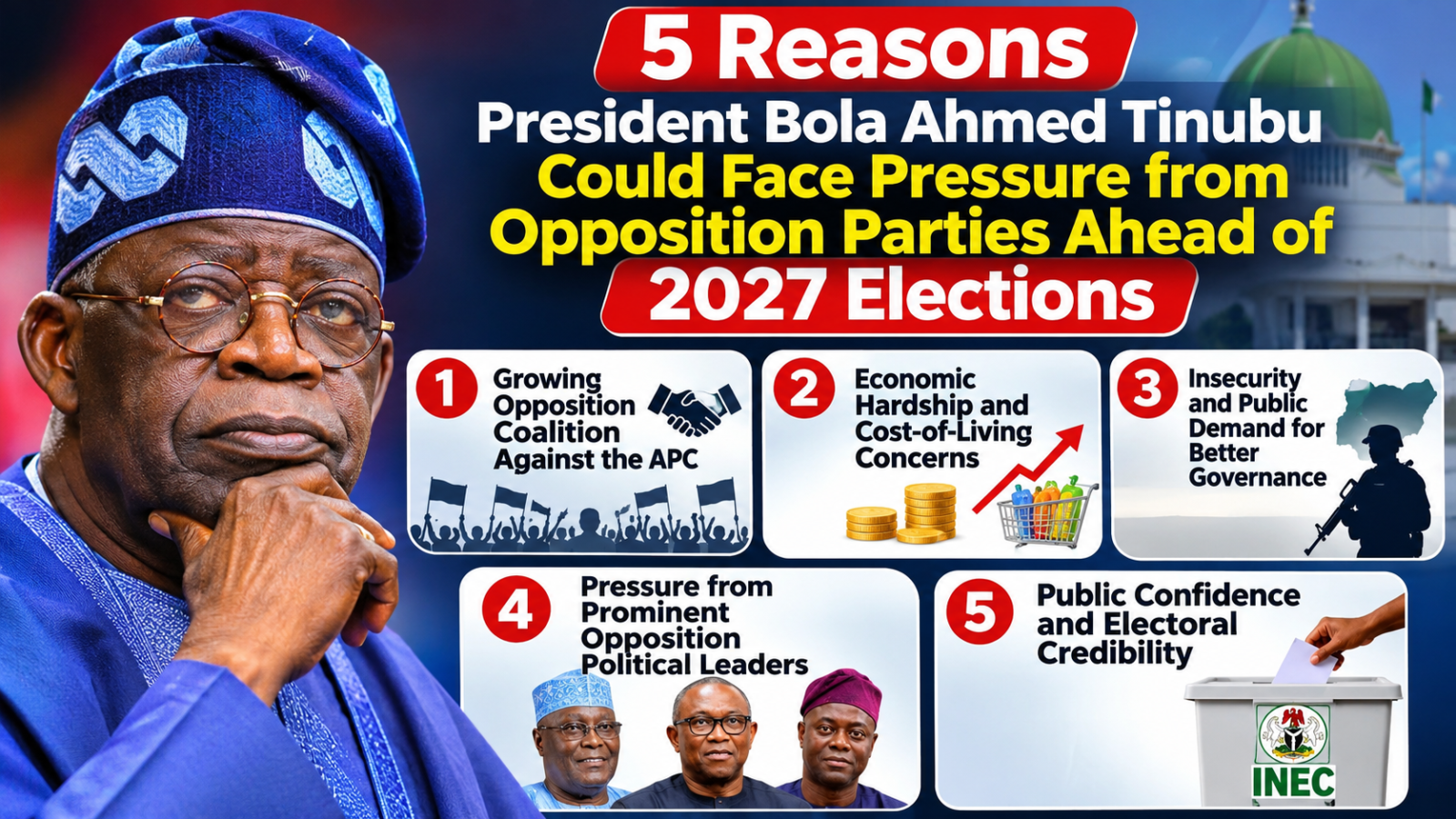
President Bola Ahmed Tinubu could face an increasingly competitive political environment ahead of the 2027 general elections as opposition parties intensify efforts to build a united front against the ruling All Progressives Congress (APC).
The emerging Coalition for Democracy, involving six opposition parties, is seeking to establish a common political agreement that could strengthen cooperation among opposition leaders and provide an alternative platform for Nigerians.
With a coalition summit scheduled for November 30, 2026, political attention has shifted towards the possibility of greater opposition unity and its implications for Tinubu’s second-term ambition.
Although there is no confirmed indication that Tinubu intends to step down for any opposition candidate, several political and economic developments could shape the contest.
Here are five factors attracting attention ahead of the 2027 presidential election.
1. Growing Opposition Coalition Against the APC
One major development is the renewed effort by opposition parties to establish a coordinated political alliance against the APC.
The Coalition for Democracy includes the African Democratic Congress (ADC), Allied Peoples Movement (APM), Nigeria Democratic Congress (NDC), Peoples Democratic Party (PDP), Peoples Redemption Party (PRP) and Social Democratic Party (SDP).
The parties are expected to formalise their cooperation through a public agreement at their November 30 summit in Abuja.
Former Vice President Atiku Abubakar, former Anambra State Governor Peter Obi and Oyo State Governor Seyi Makinde are among the prominent political figures associated with the opposition discussions.
If the parties establish an effective framework for cooperation, it could change the dynamics of the 2027 presidential contest.
2. Economic Hardship and Cost-of-Living Concerns
Economic conditions remain an important issue in Nigeria’s political discussions.
The removal of petrol subsidies and foreign exchange reforms introduced under the Tinubu administration have generated significant economic adjustments.
Rising living costs, transportation expenses and concerns about household purchasing power could become major issues during the 2027 campaigns.
Opposition parties are likely to scrutinise the administration’s economic record and present alternative proposals.
The extent to which Nigerians experience improvements in their economic circumstances before the election could influence public assessments of the government’s performance.
3. Insecurity and Public Demand for Better Governance
Security remains another important issue facing the Federal Government.
Persistent concerns about terrorism, banditry, kidnapping and communal violence have continued to feature prominently in national political discussions.
Opposition politicians have criticised the government’s handling of insecurity and are expected to make national security a major campaign issue.
The Tinubu administration, meanwhile, has maintained that it is taking steps to strengthen security operations and address the country’s security challenges.
The effectiveness of these measures will remain an important subject of public scrutiny ahead of the 2027 elections.
4. Pressure from Prominent Opposition Political Leaders
The involvement of prominent political figures could make the emerging opposition arrangement an important development in the 2027 political landscape.
Atiku Abubakar, Peter Obi and Seyi Makinde have been associated with consultations on opposition cooperation.
Their participation raises important questions about how the parties will manage competing presidential ambitions, regional interests and political differences.
Makinde has publicly confirmed ongoing discussions with opposition figures, emphasising that decisions about political cooperation should be based on manifestos, previous performance and public sentiment.
However, the coalition has yet to demonstrate that all participating parties can agree on a common presidential candidate.
5. Public Confidence and Electoral Credibility
Public confidence in the electoral process could also shape the 2027 presidential contest.
The Coalition for Democracy has identified electoral integrity and the protection of votes as important areas of cooperation among its members.
The opposition parties have indicated their intention to work together to protect the democratic process and ensure that voters’ choices are respected.
A transparent, peaceful and credible election will be important for all political parties, including the APC and its opposition challengers.
The Independent National Electoral Commission (INEC) and other relevant institutions will face expectations to ensure that the electoral process meets constitutional and legal requirements.
Conclusion
The emerging opposition coalition, economic concerns, insecurity, prominent political figures and electoral credibility are among the issues that could shape President Tinubu’s political future ahead of the 2027 general elections.
However, the opposition parties must still resolve questions surrounding leadership, candidate selection, political interests and the implementation of their proposed agreement.
Tinubu has continued his political mobilisation for another term, while some political parties and leaders have also declared support for his re-election.
Ultimately, the 2027 election will be determined through the constitutional electoral process, not simply through political negotiations or predictions about whether any candidate will step down.