
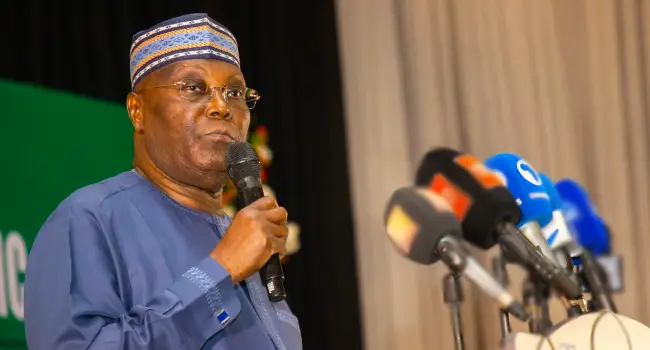
Leaders of the African Democratic Congress (ADC) in Nigeria’s South-West have reportedly expressed dissatisfaction with former Vice President Atiku Abubakar over his alleged marginalisation of the party’s regional structure ahead of the 2027 general elections.
The party leaders accused Atiku, who is seeking the ADC presidential ticket, of conducting political activities in the region through his friends and allies while allegedly sidelining the party’s established leadership.
According to a report by Punch, the development has generated disaffection among ADC members in the South-West and contributed to the slow pace of campaign activities for Atiku in the region.
The South-West remains a significant political battleground, particularly because it is widely regarded as the stronghold of President Bola Tinubu.
During the 2023 presidential election, Tinubu won Ogun, Oyo, Ekiti and Ondo states, while Atiku, who contested under the Peoples Democratic Party (PDP), won Osun State. Peter Obi of the Labour Party secured victory in Lagos State.
With the 2027 general elections approaching, the reported disagreement between Atiku and some ADC leaders could present a challenge to efforts to strengthen the party’s presence in the region.
ADC Leaders Complain About Atiku’s Alleged Neglect
Some ADC insiders in the South-West reportedly expressed concern that Atiku might not be willing to commit sufficient resources to political activities in the region.
One party official alleged that the presidential aspirant had refused to provide financial support to the party, citing an incident involving the six South-West state chairmen.
According to the official, the chairmen travelled to Abuja on September 17 for a meeting with Atiku but were allegedly not given transport allowances.
“You can imagine a situation where the party chairmen in the six South-West states went to Abuja to attend a meeting with him (Atiku) on September 17 and our presidential candidate refused to give them transport fare. The chairmen are not happy with him for that. Maybe he is just targeting his 25 per cent in the region,” the official reportedly said.
The allegation has fuelled concerns among some party members about Atiku’s level of commitment to building the ADC’s political structure across the South-West.
However, the claims represent the accounts of party insiders cited in the report and have not been independently established.
ADC Governorship Candidates Raise Concerns With Aregbesola
The disagreement reportedly came to the fore at a meeting held in Ibadan, the Oyo State capital, on September 4.
According to the report, ADC governorship candidates and other party leaders from the South-West met with the party’s National Secretary, Ogbeni Rauf Aregbesola, to formally express their concerns about Atiku’s alleged failure to carry the regional structure along in his political activities.
The participants reportedly sought clarification from the national secretariat on whether Atiku intended to work through the party’s established structures or continue relying on his personal associates and political allies.
A governorship candidate who attended the meeting said nearly all the ADC leaders present complained about the alleged sidelining of the party in the region.
The candidate, who spoke on condition of anonymity because of the sensitivity of the matter, said the meeting was tense and that the leaders insisted on being recognised in the presidential campaign.
“The meeting was hot. We told the national secretariat, through Aregbesola, that Atiku must respect the party structure and channel his campaign through it,” the candidate reportedly said.
The candidate added that the leaders rejected the alleged practice of using Atiku’s friends and loyalists to coordinate political activities that should ordinarily involve the party’s official structures.
The candidate further argued that the ADC structures responsible for producing candidates for the 2027 governorship, National Assembly and state assembly elections should be involved in the presidential campaign.
Atiku Reportedly Promises to Address Grievances
Following the meeting in Ibadan, Atiku reportedly held a virtual meeting with ADC leaders in the South-West on September 5.
An ADC leader who attended the discussions said the former vice president reaffirmed his loyalty to the party and promised to address the concerns raised by the regional leaders.
According to the source, Atiku asked each state to submit five names of party members for appointment to his campaign committee.
The move was reportedly intended to improve the participation of the party’s existing structures in his political activities.
However, the ADC leader claimed that the promised changes had yet to produce significant results.
“He (Atiku) promised that there would be a change and that the party would henceforth be carried along in his political activities. But little has really changed since then,” the source reportedly said.
The allegation suggests that concerns over representation and coordination within the party remain unresolved, despite the reported engagement between Atiku and regional leaders.
ADC Candidate Says Atiku’s Campaign Lacks Visibility
An ADC House of Assembly candidate in Ekiti State also reportedly criticised the level of engagement between Atiku and the party’s South-West structure.
The candidate argued that Atiku’s campaign lacked visibility in the region because the party’s grassroots and established leadership had not been sufficiently involved.
The candidate described the situation as discouraging, alleging that the former vice president had not paid adequate attention to the party in the region.
The reported complaints highlight the importance of cooperation between presidential aspirants and state-level party organisations, particularly as political parties prepare for the 2027 general elections.
South-West Remains Crucial to 2027 Presidential Contest
The South-West is expected to remain an important factor in the 2027 presidential election, given its political significance and President Tinubu’s electoral performance in the region in 2023.
For Atiku and the ADC, building an effective campaign network could depend partly on the ability to reconcile competing interests and ensure that state chairmen, governorship candidates and grassroots organisers are involved in political mobilisation.
The reported disagreements also point to potential challenges in coordinating campaign activities across the region if the concerns raised by party members are not addressed.
For now, the extent to which the alleged dispute will affect the ADC’s preparations for the 2027 elections remains uncertain.
Neither the reported complaints nor the accounts attributed to anonymous party insiders establish the full extent of the disagreement. The situation underscores the need for effective coordination between the party’s national leadership, presidential campaign team and regional structures as preparations for the next general election continue.