
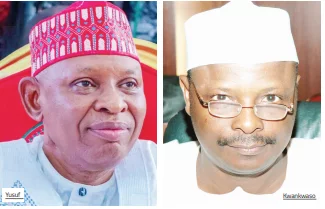
After weeks of speculation regarding his next political move, the Governor of Kano State, Abba Yusuf, finally joined the All Progressives Congress (APC), signalling his readiness to seek a second term in the 2027 general elections.
To many political observers, Governor Yusuf’s decision to abandon the New Nigeria People’s Party (NNPP) constitutes a significant betrayal. This sentiment is fuelled by accusations that he is “biting the hand that fed him,” especially following a stern warning of impending political consequences from Rabiu Kwankwaso, the NNPP’s national leader.
The governor’s loyalists, however, view his defection to the ruling party as a political masterclass aimed at ensuring the longevity of his administration. Explaining his reasons for leaving the NNPP, Governor Yusuf stated last week that the party has faced persistent internal challenges, including leadership disputes and ongoing legal battles, many of which are still awaiting judicial determination. He noted that growing disenfranchisement among party members has caused profound structural divisions, manifesting as irreconcilable rifts and systemic uncertainty.
Yusuf added, “After careful reflection, and without prejudice to the party’s capacity to resolve its internal challenges, I have come to the conclusion that my resignation is in the best interest of the people of Kano State.”
The complication with the governor’s position is that he is a product of the political ideology known as Kwankwasiyya, pioneered by Kwankwaso. The “wounded” Kwankwaso has vowed to exercise his full influence to prevent his estranged political godson from securing another term in the Kano State Government House in 2027.
The former governor has also expressed his frustration publicly, stating, “Many people I spoke to felt it was some kind of arrangement between him and me, or between him and others. Even I often find it hard to believe that things are unfolding the way they are.”
He continued, “When I lie down, I ask myself: what really happened? Who was at fault? Was it me? Was it the party? Were party members at fault? But I have not been able to find an answer.”
Kwankwaso, who was deeply shaken along with other members of the NNPP, refused to believe Yusuf was leaving the party until Abdullahi Ganduje—Kwankwaso’s eternal political rival and immediate past governor of Kano State—publicly raised Yusuf’s hand. At that moment, he realized that the party had lost its most prized asset.
Kwankwaso called Yusuf a betrayer and expressed deep disappointment that the governor had “handed over the mandate of NNPP members and the people of Kano to the Gandujiyya political camp” without strong justification.
The Gandujiyya camp is led by Ganduje, whose resignation as the National Chairman of the APC in June 2025 was widely seen as a precursor to political realignments involving the Kwankwasiyya movement and the ruling party. While the APC announced Ganduje resigned for health reasons, political analysts argued that President Bola Tinubu sought to bring Kwankwaso into the party to secure northern support for the 2027 elections, allegedly making him willing to “sacrifice” Ganduje’s leadership.
According to party insiders, negotiations between the APC and the Kwankwasiyya Movement stalled because both parties could not reach common ground. Kwankwaso consistently demanded a guarantee for either the presidential or vice-presidential candidacy as a condition for joining any political party—a demand stakeholders said could not be met because removing Vice President Kashim Shettima might trigger political backlash in Northern Nigeria.
Sources revealed that the APC then turned back to Ganduje, urging him to lead the charge in Kano, despite his appointment as Board Chairman of the Federal Airports Authority of Nigeria following his controversial resignation as the party’s National Chairman. Yusuf now relies on the political influence of President Tinubu and the Gandujiyya camp to defeat Kwankwaso and his loyalists in 2027. He has already been offered the APC governorship ticket but faces uncertainty as he enters a critical stage of his political career.
Political analyst Nura Wanbai told The Point, “I pity those who might want to underestimate Ganduje’s political influence in Kano. Ganduje served as deputy to Kwankwaso during the latter’s tenure as governor. Some assume he remains subservient to Kwankwaso—a view I do not share. Ganduje is a major force in Kano, and belittling him would be a mistake. Furthermore, the ‘Tinubu factor’ will undoubtedly serve as a strategic advantage for him on the political battlefield. I do not subscribe to the rhetoric regarding payback and revenge from Kwankwaso and his followers. Instead, I suggest he focuses on getting his own house in order.”
Governor Yusuf may find some vindication in the support from the NNPP faction led by the party’s founder, Boniface Aniebonam, which defended his defection to the APC as an escape from political subjugation. Aniebonam registered the NNPP in 2001 and offered it to Kwankwaso as a platform for the 2023 general elections. However, the relationship between the two men deteriorated after the election.
The Aniebonam faction claims that Yusuf left the Kwankwasiyya Movement and the NNPP due to Kwankwaso’s attempts at subjugation, rather than for selfish reasons as some suggest. They argued that Kwankwaso, not Yusuf, was the actual betrayer for breaching Aniebonam’s trust and noted that Yusuf’s reconciliation efforts were repeatedly rebuffed by Kwankwaso’s “arrogance and greed.”
The NNPP loyal to Kwankwaso, who insist there are no factions in the party, condemned Yusuf’s defection, accusing the Federal Government of undermining true federalism and reducing state governors to mere subordinates of the presidency. Magaji Mato, NNPP Executive Council member and National Legal Adviser, said during a television interview that the NNPP sees Aniebonam as a “nuisance” who should contribute to the party’s growth rather than its decline. Mato stated, “He is somebody who has given himself out to be used by opponents to destroy a system he should have nurtured.”
Political analyst Benedict Njoku suggested that Kwankwaso should join the African Democratic Congress (ADC) to exert his political weight. He said an alignment with the ADC and former Vice President Atiku Abubakar could end Yusuf’s bid for a second term. Njoku added, “What we are experiencing in Kano State did not take some of us by surprise. We knew the battlefield would be set this way. Kwankwaso and his group should stop acting like children who have had their candy taken away. This is politics, and it is a dirty game. If the Kwankwasiyya Movement wants to defeat Yusuf in 2027, they should appeal to their leader to join the ADC. They cannot achieve victory in Kano if they remain in the NNPP. This is not 2023 when none of the major contenders was in power. Tinubu is in charge now, and things have changed. Kwankwaso needs an alliance with Atiku Abubakar to challenge Yusuf, Ganduje, and Tinubu in Kano. His political relevance depends on joining the ADC; if he aligns with Atiku, Yusuf’s path to re-election in 2027 will become much more difficult.”..See More