
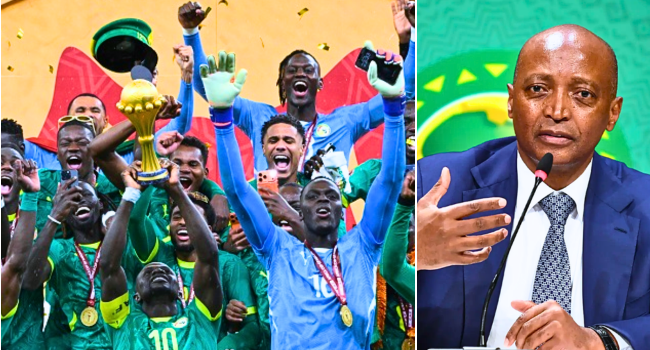
The Confederation of African Football (CAF) has reversed its decision to hold the Africa Cup of Nations (AFCON) every four years, confirming that the continental football tournament will return to its traditional two-year cycle.
The decision was unanimously approved by the CAF Executive Committee (EXCO), according to a statement from the continent’s football governing body.
CAF President Patrice Motsepe had earlier announced at the organisation’s Strategy Conference in Cabo Verde, held from October 7 to 9, 2026, that the executive committee would reconsider the proposed four-year AFCON schedule.
The reversal follows concerns about the financial implications of replacing the biennial Africa Cup of Nations with a proposed Africa Nations League, which could take several years to generate sufficient revenue to support CAF competitions and football development across Africa.
CAF Explains Decision to Restore Biennial AFCON
Motsepe said the decision to return AFCON to a two-year cycle was taken to protect African football, the interests of CAF’s 54 member associations and African players employed by clubs outside the continent.
According to the CAF president, the proposed Africa Nations League was expected to deliver financial and football development benefits similar to those provided by the Africa Cup of Nations.
However, he explained that the competition would require several years to achieve those objectives, making it necessary for CAF to reconsider its plans.
Motsepe said the decision was guided by the need to advance, protect and promote the interests of African football and its stakeholders.
He also emphasised the importance of safeguarding the interests of African players competing for clubs outside the continent.
The return to a biennial schedule is expected to maintain AFCON’s importance as a major source of revenue and a platform for football development across Africa.
AFCON 2027 to Be Hosted by Kenya, Tanzania and Uganda
Under the revised schedule, the next Africa Cup of Nations will take place in 2027, with Kenya, Tanzania and Uganda jointly hosting the tournament.
The subsequent editions are scheduled for 2028, 2031 and 2033, according to the revised calendar outlined by CAF.
The 2027 tournament will mark a significant moment for East African football, with the three host countries preparing to welcome national teams, supporters and visitors from across the continent and beyond.
Motsepe expressed confidence that the tournament would be successful, highlighting the importance of the competition to African football and the continent’s wider sporting development.
The joint hosting arrangement is also expected to provide an opportunity for the three countries to showcase their infrastructure, hospitality and capacity to stage a major international football event.
Why AFCON Will Not Take Place in 2030
Motsepe explained that CAF would not organise AFCON in 2030 because the FIFA World Cup is scheduled to take place that year.
He said CAF’s national team competitions would not be held in the same year as the World Cup, in keeping with FIFA’s established tradition.
The revised AFCON calendar therefore places the tournament in 2027 and 2028 before returning to editions in 2031 and 2033.
The scheduling adjustment is intended to accommodate the international football calendar while preserving the financial and sporting value of the Africa Cup of Nations.
AFCON Remains Central to African Football
Motsepe described the Africa Cup of Nations as more than a football competition, saying it provides an opportunity to celebrate Africa’s cultural diversity and bring people together.
The tournament brings together national teams representing CAF’s 54 member associations and attracts supporters from across Africa, the African diaspora and other parts of the world.
Beyond the competition on the pitch, AFCON offers commercial opportunities through broadcasting, sponsorship, tourism and other related activities.
CAF’s decision to restore the two-year cycle is intended to protect these benefits while supporting the development of football across the continent.
The biennial format also gives African national teams more regular opportunities to compete for continental honours and allows supporters to experience one of the continent’s biggest sporting events more frequently.
What CAF’s Decision Means for Future AFCON Tournaments
The reversal means CAF will retain the Africa Cup of Nations as a biennial competition rather than transition to a four-year schedule.
The decision also reflects concerns about the time required for the proposed Africa Nations League to generate comparable financial returns and support football development programmes.
For CAF and its member associations, maintaining AFCON every two years is expected to preserve a more regular source of commercial revenue while strengthening the tournament’s position in international football.
With Kenya, Tanzania and Uganda scheduled to host the 2027 edition, attention will now turn to preparations for the tournament and the implementation of CAF’s revised competition calendar.
The return to the traditional format is expected to keep AFCON at the centre of African football, combining international competition with commercial opportunities and a celebration of the continent’s sporting and cultural identity.