
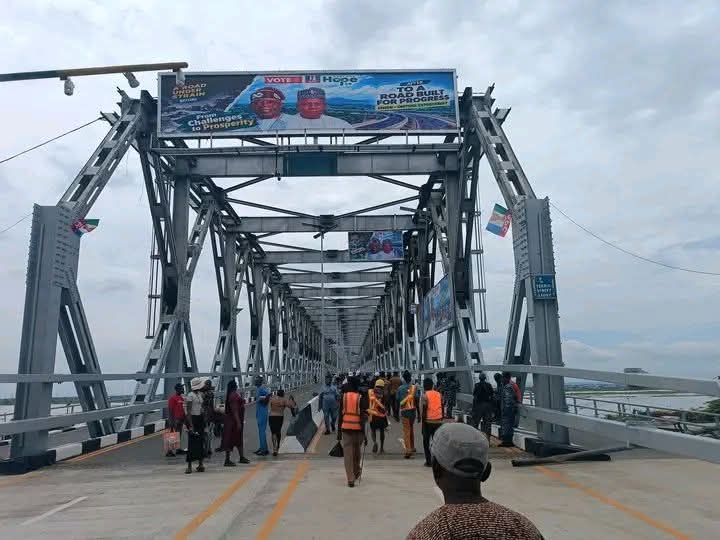
The Federal Government has reopened the First Niger Bridge to traffic after about 38 days of closure, restoring the vital transportation link between Onitsha in Anambra State and Asaba in Delta State.
The Minister of Works, Dave Umahi, announced the reopening on Thursday during a ceremony at the Onitsha end of the bridge. The event was attended by federal and state government representatives, as well as traditional rulers from Anambra and Delta states.
The reopening is expected to ease transportation challenges for motorists, commuters and businesses that rely on the strategic bridge connecting the South-East and South-South regions.
Why the First Niger Bridge Was Closed
The First Niger Bridge, which was constructed in 1965, was initially closed to traffic from September 7 to September 21 to allow emergency rehabilitation and maintenance work.
The closure followed the discovery of vandalised structural components, including steelwork associated with the bridge’s expansion joints.
Although the Federal Government initially scheduled the reopening for September 21, the closure was extended indefinitely because of persistent rainfall and other unforeseen circumstances that delayed the rehabilitation work.
The extended closure disrupted movement between Onitsha and Asaba, making the reopening a significant development for road users and commercial operators who depend on the route.
Umahi Says Bridge Repairs Will Improve Road Safety
Speaking at the reopening ceremony, Umahi said the necessary infrastructure had been fixed to facilitate the free flow of traffic.
He explained that the rehabilitation work was designed to reduce congestion and improve the safety of motorists using the bridge.
The minister also commended the governors of Anambra and Delta states for their support during the intervention, while praising the contractor, SKCC, for its efforts.
“We must commend the contractors, SKCC, very, very highly; they have worked very well. We are not 100 per cent done because we are going to do [more work],” Umahi said.
His remarks indicated that although the bridge had reopened to traffic, some additional work remained to be completed.
The reopening restores an important transport corridor used by private motorists, commercial vehicles and businesses moving goods between the two states and other parts of southern Nigeria.
Umahi Praises Tinubu Over South-East, South-South Infrastructure
During the ceremony, Umahi praised President Bola Tinubu for what he described as his administration’s commitment to infrastructure development in the South-East and South-South regions.
He argued that the rehabilitation of the First Niger Bridge demonstrated the Federal Government’s willingness to invest in infrastructure across different parts of the country.
“The evidence of what we are doing today is a total testimony that President Bola Tinubu is indeed a detribalised Nigerian,” the minister said.
Umahi also referenced previous challenges associated with road infrastructure in the South-East, including the Enugu-Onitsha Road, while defending his support for the President.
“We have no regret supporting President Bola Tinubu. Let me declare, in opening this bridge, that I have no regret supporting Mr President,” he added.
Minister Calls for Tinubu’s Re-election
Umahi used the bridge reopening ceremony to urge residents of the South-East and South-South to support Tinubu’s re-election bid ahead of the January 16, 2027 date he cited.
The minister said he believed the President deserved recognition for infrastructure projects being undertaken in the regions.
He further expressed confidence in Tinubu’s leadership, describing him as qualified to continue leading the country.
His comments added a political dimension to the ceremony, which was primarily organised to mark the restoration of traffic on the strategic bridge.
Importance of the First Niger Bridge to Southern Nigeria
The First Niger Bridge remains a critical transport link between Onitsha, one of Anambra State’s major commercial centres, and Asaba, the capital of Delta State.
Its reopening is expected to restore smoother movement for commuters, traders, logistics operators and other road users travelling between the South-East and South-South.
The bridge also plays an important role in the movement of goods and services along a major commercial corridor in southern Nigeria.
With traffic restored following the extended maintenance closure, motorists can resume using the route, although the Federal Government has indicated that some rehabilitation activities are yet to be fully completed.
The reopening marks an important step in restoring normal movement across the River Niger crossing while highlighting the continuing need to maintain critical transport infrastructure.