
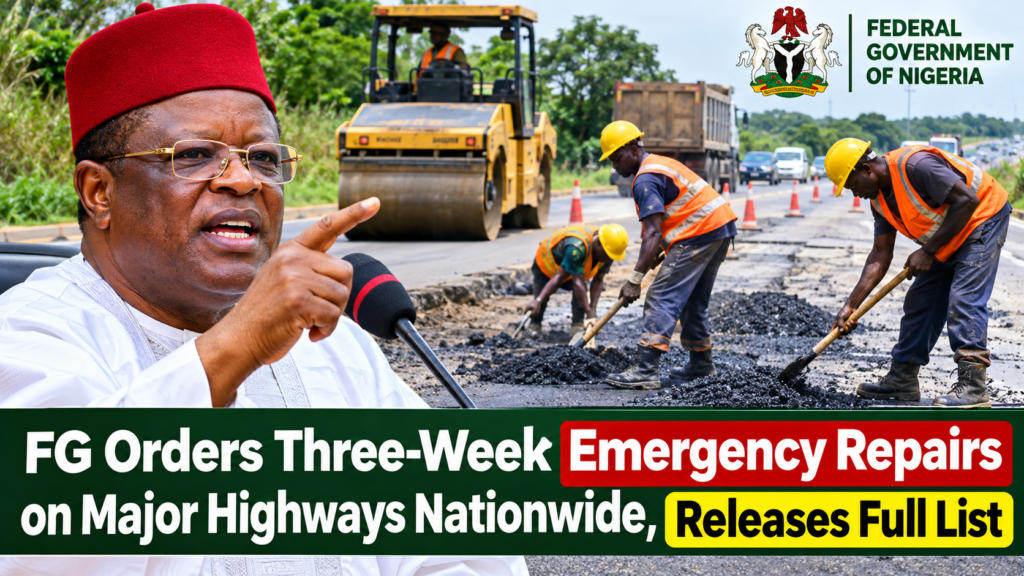
The Federal Government has declared a three-week emergency operation to repair failed sections of major federal highways across Nigeria ahead of the Christmas travel rush and the January 2027 elections.
The Minister of Works, David Umahi, announced the directive on Friday in Abuja during a meeting with zonal directors of the Federal Ministry of Works at the ministry’s headquarters in Mabushi.
Umahi directed contractors and ministry officials to immediately return to construction sites and prioritise emergency repairs on deteriorating highway sections to ensure safer and smoother movement for motorists.
The minister expressed displeasure over the practice of contractors concentrating on permanent construction work on one section of a highway while other portions of the same road remained severely damaged and almost impassable.
He warned that such an approach would no longer be tolerated, insisting that emergency repairs must take priority wherever roads have collapsed, even when major reconstruction projects are ongoing.
According to him, the three-week intervention will focus on restoring failed portions of highways through targeted rehabilitation works.
The repair process will involve cutting out damaged road sections, removing unsuitable soil, filling affected areas with laterite and sharp sand, and applying stone base mixed with either 3.5 per cent or five per cent cement, depending on the condition of the road.
The affected portions will subsequently receive binder and wearing courses to improve their durability and provide smoother driving surfaces.
Umahi also directed contractors to repair road shoulders and drainage systems as part of the emergency intervention.
He further instructed that completed road sections that had been allowed to cure for at least 21 days should be opened to motorists, provided they were certified safe for public use.
FG Prioritises Emergency Repairs Amid Funding Constraints
Explaining the reason behind the nationwide intervention, Umahi said the Tinubu administration inherited a severely deteriorated road network, with several major highways experiencing significant failures simultaneously.
He noted that limited financial resources had made it necessary for the government to adopt strong palliative measures to maintain road accessibility while comprehensive reconstruction projects continued.
The minister recalled that when President Bola Tinubu assumed office, motorists could hardly travel for 30 minutes without encountering potholes or severely damaged sections of federal highways.
He said the government’s immediate priority was to keep critical transport routes functional while working towards long-term infrastructure improvements.
Abuja-Kaduna-Zaria Road Nears Completion
Umahi also provided an update on the Abuja-Kaduna-Zaria Road, revealing that the project was approximately 95 per cent completed.
He further claimed that there had been no reported kidnapping incidents along the highway in the last two years, highlighting the improved security situation on the route.
The road remains one of Nigeria’s important transportation corridors, connecting the Federal Capital Territory with Kaduna and other parts of the North-West.
Full List of Federal Roads Listed for Emergency Repairs
The Federal Ministry of Works identified several major highways across the six geopolitical zones for immediate intervention.
The roads listed for emergency repairs include:
North-West and North-East
-
Maiduguri Sections 4 and 5.
-
Numan-Jalingo Road, alongside other failed sections in Adamawa and Taraba states.
North-Central
South-South and South-West
South-East
-
Enugu-Port Harcourt Road, particularly the Enugu-Aba section.
-
Enugu-Abakaliki-Ogoja Road.
Umahi Orders Contractors to Repair Previously Completed Roads
In another directive, the minister instructed contractors to revisit highways and road sections they had previously completed but which had deteriorated again.
He stressed that contractors must take responsibility for correcting failed portions of their projects rather than leaving motorists to suffer the consequences of deteriorating infrastructure.
The three-week emergency operation is expected to improve road conditions across major transportation corridors before increased holiday traffic and the January 2027 elections.
The success of the intervention will depend on how quickly contractors return to their sites, the quality of materials used and the government’s ability to ensure proper supervision of the repair works.