
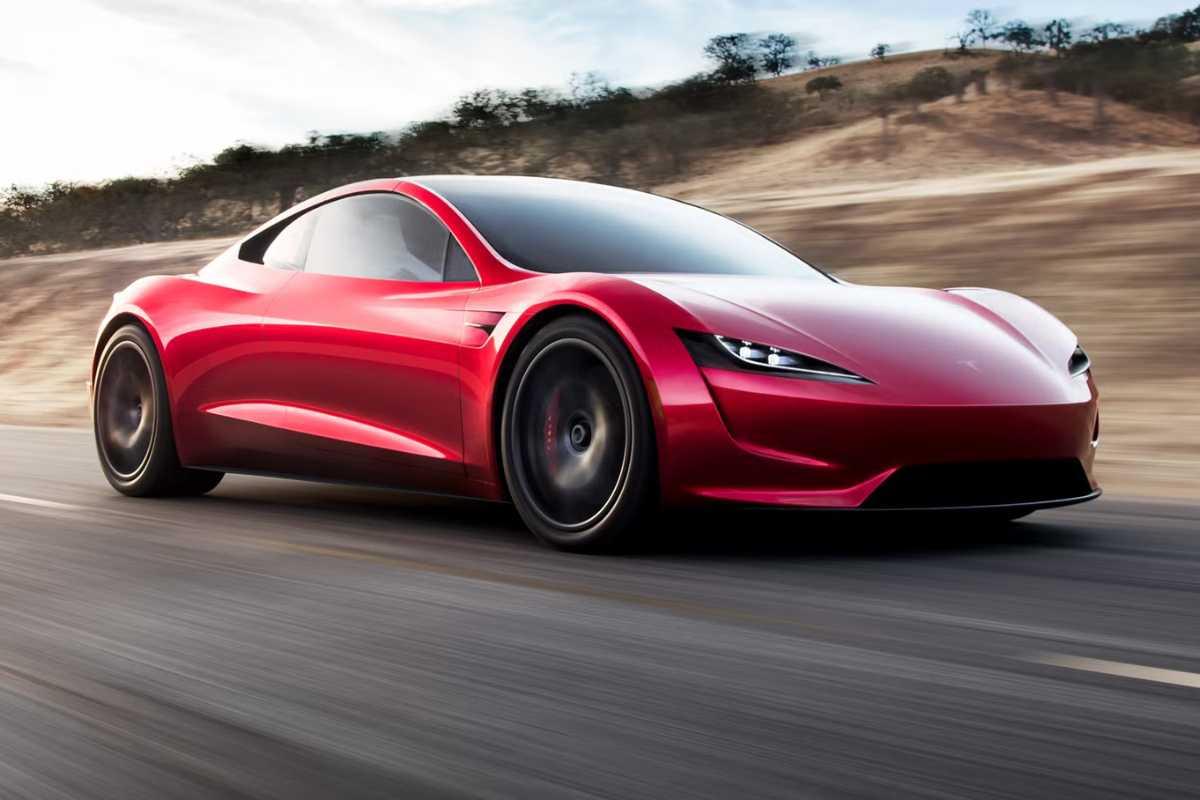
Elon Musk has made a bold claim about Tesla’s next-generation Roadster, describing the electric sports car as a potential flying vehicle equipped with rocket-like thrusters developed using technology associated with his aerospace company, SpaceX.
During a demonstration at a SpaceX rocket development and testing facility in Texas, the billionaire entrepreneur reportedly showcased the Tesla Roadster 2 performing a series of dramatic manoeuvres, including a ramp ascent, an aerial flip and a jump over a line of existing Tesla vehicles.
Musk said the vehicle featured altitude controls, thrusters and rear-mounted main thrusters that could allow it to perform rolls and other complex movements.
“Flying cars are real,” Musk said during the event, describing the prototype as a vehicle that could “basically fly like a rocket”.
However, the extraordinary claims surrounding the demonstration, including the vehicle’s reported flight capabilities and performance figures, require independent verification.
Tesla Roadster 2 Demonstration Features Rocket-Like Thrusters
Footage described as coming from the demonstration showed the Roadster 2 approaching a curved ramp before performing a sequence of manoeuvres involving suction-based grip and thrusters.
The vehicle was reportedly operated remotely during the demonstration to reduce the risk of injury.
Musk explained that the remote-control approach was intended to ensure that nobody was harmed while the prototype was being tested.
The demonstration also reportedly showed the vehicle using its thrusters to leap over several Tesla models before accelerating away.
Although the footage was presented as a glimpse into the future of electric performance cars, it remains important to distinguish between a demonstration of a prototype and a commercially available vehicle with independently verified flight capabilities.
Musk Claims Tesla Roadster 2 Can Accelerate From 0 to 60 mph in Under One Second
One of the most striking claims associated with the Roadster 2 concerns its acceleration.
Musk reportedly said the sports car could accelerate from zero to 60 miles per hour in less than one second, a performance figure that would be extraordinary even by the standards of high-performance electric vehicles.
The vehicle is also said to feature specialised thrusters that could support aerial manoeuvres.
If such capabilities are demonstrated and independently verified, they would represent a significant departure from the conventional electric sports car design.
Nevertheless, the claimed acceleration, flight system and manoeuvrability should not be treated as established specifications without reliable test results and technical documentation.
Tesla Roadster 2 Price and Reservation Deposits
The next-generation Roadster has been associated with a planned production timeline of 2028 and a starting price exceeding $200,000, according to the supplied report.
The vehicle was originally presented as an ambitious electric sports car intended to challenge high-performance petrol-powered models.
The report also describes several reservation options for prospective customers.
A performance version reportedly requires a £50,000 deposit, while a thrust-equipped version carries a reported $250,000 deposit. A single-seat rocket variant featuring a full flight system was described as available by invitation only.
These reservation details, prices and production plans should be confirmed against Tesla’s official ordering information before customers make financial commitments.
Tesla has also reportedly indicated that the flying configuration would not be permitted on public roads.
Elon Musk Acknowledges Potential Legal and Safety Concerns
Despite the excitement surrounding the reported demonstration, Musk acknowledged that the vehicle’s unusual capabilities could create regulatory challenges.
“I’m not sure it’s necessarily legal in all jurisdictions,” he said, according to the supplied report.
He also described the prototype as not necessarily optimised for safety, while emphasising its entertainment value.
Such remarks highlight the significant hurdles that any road-going vehicle with rocket-like propulsion or genuine flight capabilities would face.
Beyond performance engineering, a commercially viable flying car would require careful consideration of aviation regulations, road safety requirements, propulsion-system risks, operating restrictions and the protection of people nearby.
Until those issues are addressed and the technology is independently validated, the Roadster 2’s reported flight features remain claims rather than confirmed capabilities.
From Electric Sports Car to Flying-Car Ambitions
Musk previously expressed scepticism about the idea of a future dominated by flying cars, according to the supplied report.
His later plans for the next-generation Roadster represented a different vision: an electric sports car designed to deliver extreme acceleration and challenge traditional performance vehicles.
The latest reported demonstration takes that ambition further by suggesting that the vehicle could incorporate technology inspired by SpaceX’s rocket-development work.
However, there is a significant difference between a conceptual demonstration, a functioning prototype and a production-ready vehicle approved for public use.
For now, the Roadster 2’s reported thrusters, flight capabilities, acceleration claims, pricing and production schedule require confirmation through reliable primary sources and independent testing.
If Tesla can substantiate these claims, the project could mark an unusual development in the relationship between electric vehicles and aerospace engineering. Until then, the prospect of a commercially available flying Tesla remains a claim that warrants careful scrutiny.