
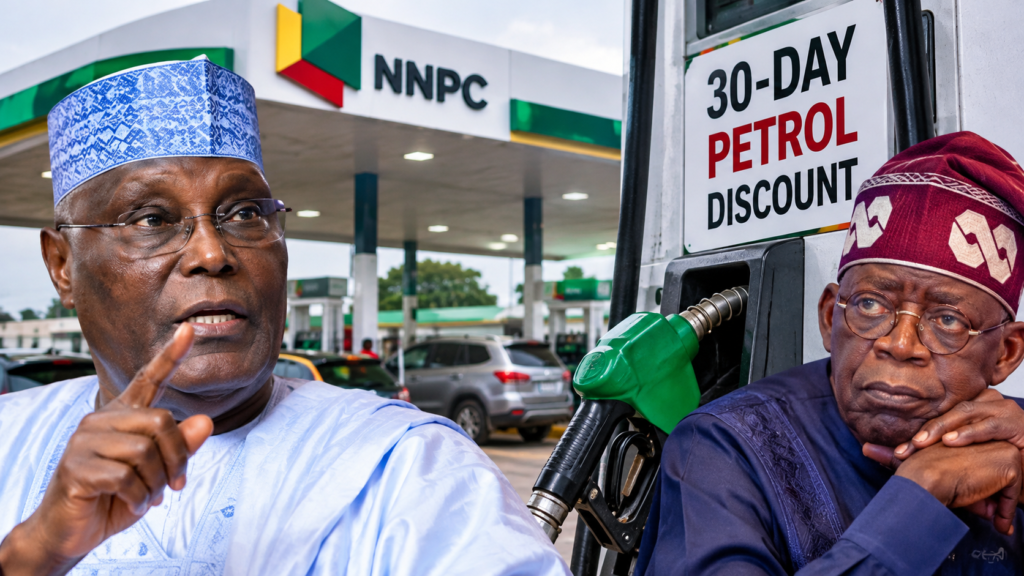
Former Vice President Atiku Abubakar and the Nigeria Democratic Congress (NDC) have criticised the Federal Government’s proposed 30-day petrol discount at Nigerian National Petroleum Company Limited (NNPC) filling stations, questioning whether the initiative will provide meaningful and lasting relief amid rising living costs.
The criticism followed an announcement by the Minister of Finance and Coordinating Minister of the Economy, Taiwo Oyedele, who said on Thursday that the planned discount was not a fuel subsidy but an arrangement to sell petrol at cost for an initial period of 30 days.
According to Oyedele, public transport operators would receive priority under the initiative, which the government hopes will provide some relief to Nigerians struggling with the high cost of transportation and other essential goods.
However, Atiku described the measure as a temporary intervention that would do little to address the underlying economic challenges facing households, while the NDC dismissed it as “tokenism and deceit”.
Atiku Questions Tinubu Government’s 30-Day Petrol Discount
In a statement issued on Thursday by Phrank Shaibu, Director of Strategic Communication of the ADC Presidential Campaign Council, Atiku accused President Bola Tinubu’s administration of offering short-term relief after years of economic hardship.
The former vice president argued that Nigerians should not be expected to welcome a one-month petrol discount without a clear plan to address the broader cost-of-living crisis.
“Atiku totally rejects this calendar-scheduled, election-laced subsidy package. Nigerians are not fools to be offered a month of discounted fuel after years of punishing prices and then expected to forget the hardship when the discount expires. This is shameless and heartless,” the statement said.
Atiku also questioned the sustainability of the initiative, asking what would happen when the 30-day period ended and petrol prices returned to their prevailing levels.
“What happens on Day 31? Nigerians wake up to the same brutal prices, the same punishing transport fares and the same rising cost of food. The government cannot manufacture relief for one month and expect Nigerians to applaud while the hardship remains,” he said.
He maintained that a temporary reduction in petrol costs would not automatically translate into lower transport fares or more affordable food prices, particularly without a clear mechanism to ensure that consumers benefit.
Atiku Seeks Details on Petrol Discount, Proposes Local Refining Support
Atiku further questioned the government’s failure to specify the amount Nigerians would save per litre under the proposed arrangement.
He also asked how the benefits provided to transport operators would be passed on to passengers through reduced fares, warning that the intervention could have limited impact if the savings were not reflected in the cost of public transportation.
The former vice president reiterated his proposal for capped and budgeted production support tied to petrol refined in Nigeria.
According to him, such an arrangement should include safeguards to ensure that consumers receive the intended benefits while domestic refining receives adequate support.
Atiku argued that a sustainable policy framework would offer more meaningful relief than a temporary discount that expires without addressing the structural factors driving petrol prices and the cost of living.
“Nigerians need lasting relief, not a countdown to the return of hardship. Tinubu’s government cannot spend years telling Nigerians to endure, then offer 30 days of relief and call it a solution,” he said.
NDC Describes Petrol Discount as ‘Tokenism and Deceit’
The Nigeria Democratic Congress also criticised the Federal Government’s proposed intervention, questioning both its effectiveness and the number of Nigerians likely to benefit.
In a separate statement signed by its National Publicity Secretary, Osa Director, the party accused the administration of attempting to reintroduce fuel subsidy indirectly after removing the previous arrangement.
The NDC cited Oyedele’s explanation that the discount would initially last for 30 days, with public transport operators receiving priority at participating NNPC retail outlets.
“We are offering a discount on petrol dispensed by NNPC Limited for the next 30 days in the first instance, with priority for public transporters nationwide. So, it’s not a subsidy. The government is just saying we sell to you at cost,” Oyedele was quoted as saying.
Rejecting the government’s justification, the opposition party argued that the proposal was inadequate to address the economic consequences it attributed to the removal of fuel subsidy.
“This is nothing but tokenism and a Greek gift from a government that whimsically removed fuel subsidy without proper consideration, consultation, or cushions for Nigerians,” the NDC said.
The party also questioned whether designated NNPC filling stations would have sufficient capacity to serve the country’s large population, raising concerns about possible overcrowding and access to discounted petrol.
It suggested that the limited duration and restricted distribution channels could prevent many Nigerians from experiencing substantial benefits from the initiative.
Government’s Petrol Discount Raises Questions Over Transport Fares
The proposed 30-day petrol discount has drawn attention to the challenge of translating lower fuel costs into broader economic relief.
Although the government says public transport operators will receive priority, questions remain over how the discount will be implemented, the savings available per litre and whether transport fares will fall accordingly.
For commuters, lower petrol costs may not necessarily result in cheaper journeys unless transport operators pass on the savings. Similarly, households facing high food prices may see limited benefits if transportation and distribution costs remain elevated.
Atiku and the NDC have therefore called into question whether a short-term intervention at selected NNPC stations can address the wider effects of fuel price increases on businesses, commuters and household budgets.
The disagreement also highlights competing views over how the government should respond to the economic pressures associated with fuel subsidy removal: through temporary price relief or a more sustained support framework.
NDC Calls for Support for Peter Obi
Beyond its criticism of the petrol discount, the NDC used its statement to urge Nigerians to support Peter Obi and the party’s candidates.
The party presented Obi as its preferred political alternative, arguing that a different policy direction was needed to address the country’s economic challenges.
“His Excellency Peter Obi, under the NDC, will put Nigeria back on the right track,” the party said.
The statement places the proposed petrol discount within a broader political debate over the Tinubu administration’s economic policies and the opposition’s proposed alternatives.
Can a 30-Day Petrol Discount Provide Lasting Relief?
The central question surrounding the Federal Government’s proposal is whether a temporary reduction in petrol costs can produce lasting improvements in the living conditions of Nigerians.
While the government describes the initiative as a cost-based arrangement rather than a subsidy, Atiku and the NDC argue that its limited duration and questions over accessibility could undermine its impact.
The policy’s effectiveness will depend on its implementation, the actual savings available to eligible motorists and transport operators, and whether those savings translate into lower transportation costs for passengers.
For now, the government’s proposed 30-day petrol discount remains the subject of criticism from the opposition, with Atiku demanding a more sustainable framework and the NDC questioning the adequacy of the intervention.
The debate underscores the continuing pressure on the Federal Government to demonstrate how its economic policies can deliver tangible and lasting relief to Nigerians facing high fuel, transportation and food costs.