
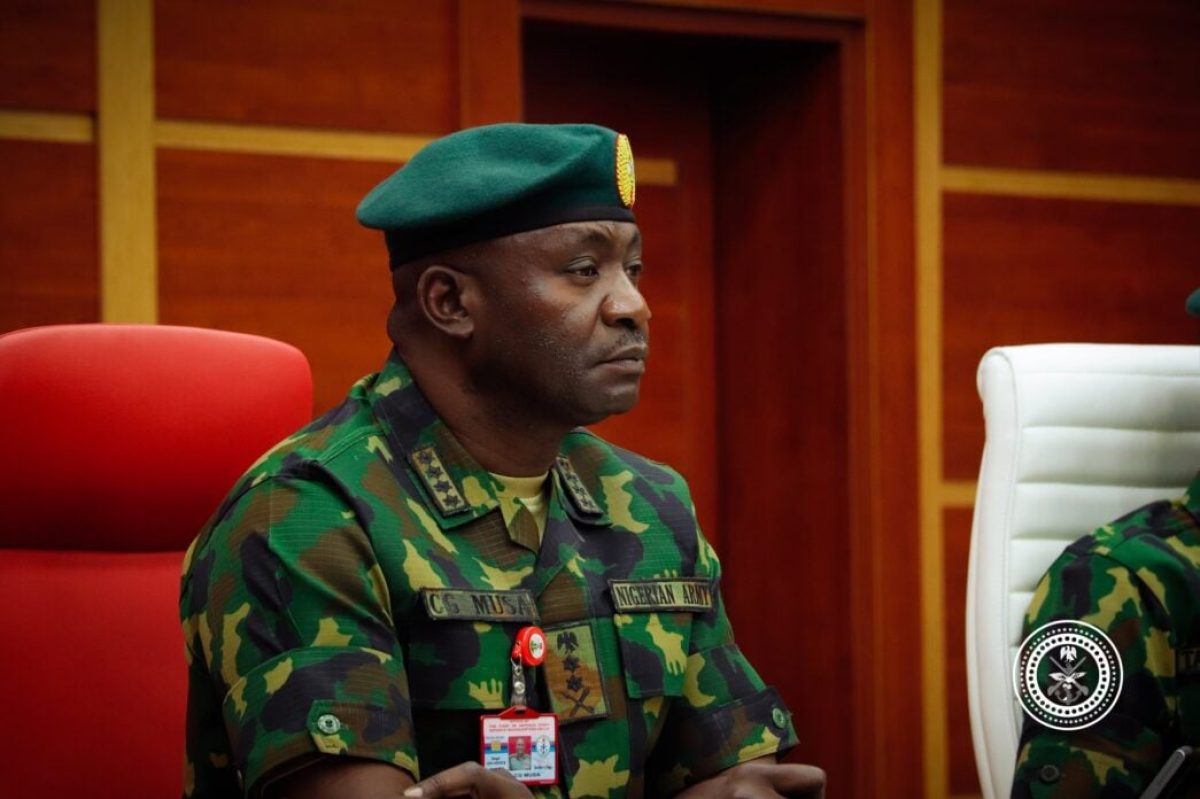
The Minister of Defence, General Christopher Musa (retd.), has said the Nigerian Armed Forces will gradually withdraw from internal security operations as the Nigeria Police Force strengthens its capacity to handle domestic security challenges.
Musa disclosed this on Thursday at the APC Abuja Roundtable in Abuja, where he acknowledged that the military had become excessively involved in internal security duties due to declining public confidence in the police.
According to the minister, although the military is constitutionally empowered to support the police when security situations exceed its operational capacity, the current level of military involvement in domestic security is too high.
“If there are issues that are beyond the police, the military can come in. But the idea is, as you said, it is too much. We are too exposed,” he said.
The defence minister explained that the military was currently supporting the police while the force worked to improve its personnel strength and operational capabilities.
He expressed optimism that the armed forces would gradually return to their traditional military responsibilities once the police became sufficiently equipped to manage internal security challenges.
“We’re assisting the police as they are building their capacity. Gradually, we too will start pulling out and going back to the barracks so that we can have time to rest,” Musa said.
Military Personnel Exhausted by Prolonged Deployments
Musa also raised concerns about the pressure prolonged internal security assignments were placing on military personnel, revealing that troops were increasingly exhausted by repeated deployments across different parts of the country.
He disclosed that he had recently attended a security assessment meeting with police authorities, including the Inspector-General of Police, to discuss strategies for improving the police force’s operational effectiveness.
“We’re looking at how we can enhance the police, because my men are tired. I can tell you for free,” he said.
The minister noted that the police were undertaking additional recruitment exercises, expressing confidence that improved manpower and operational capacity would reduce the need for military intervention in routine domestic security operations.
“We feel if they get these things right, there’s no need for the military,” he added.
He further explained that soldiers were frequently moved between operational theatres after spending extended periods in particular locations, making it difficult for many of them to maintain regular contact with their families.
“You will spend two years in one place, then you are moving to the northwest. Sometimes you don’t even see your family. It’s not like they’re enjoying it, but there’s a necessity that we have to be there,” Musa said.
Musa Calls for Restoration of Tollgates
Beyond military and police operations, the defence minister highlighted the importance of non-kinetic security measures, particularly infrastructure and effective identity management.
Musa described Nigeria’s decision to demolish tollgates as a mistake, arguing that tollgates serve important security purposes in several countries.
“I think we made a mistake destroying our toll gates. Tollgates are security measures in place anywhere in the world,” he said.
He also stressed the need for a more effective identity registration system, noting that security agencies must be able to establish the identities of people within the country.
Using a business analogy, Musa questioned how any organisation could operate effectively without knowing the identities of its employees.
“It’s like operating a company, and you don’t know your workers. It doesn’t work that way,” he said.
The minister’s remarks highlight the Federal Government’s intention to strengthen the police, reduce the burden of internal security operations on military personnel and improve other security mechanisms as Nigeria continues to address its security challenges.