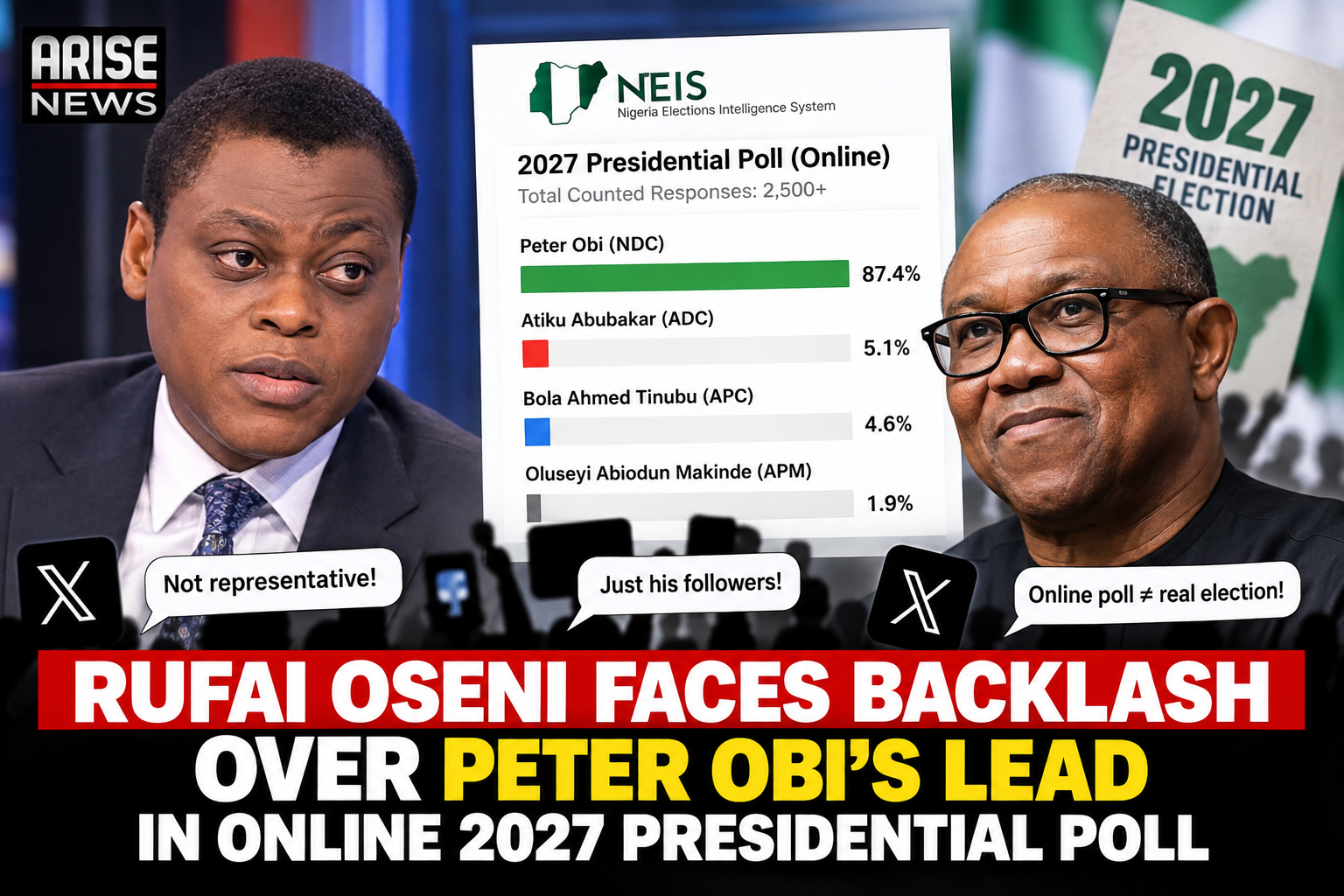
Arise Television co-host Rufai Oseni has come under fire on social media after sharing the results of an online civic opinion poll that placed Peter Obi well ahead of other major contenders in a hypothetical 2027 presidential race.
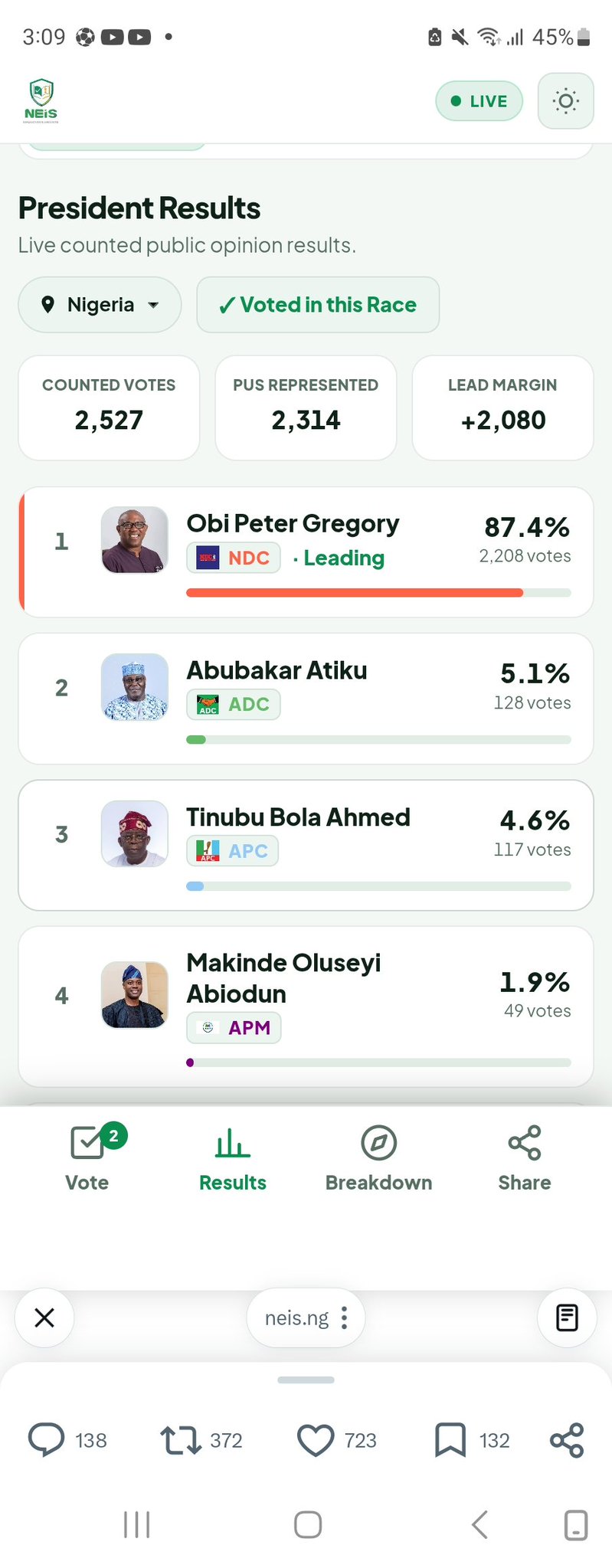
On Tuesday, September 15, 2026, Oseni shared a screenshot from the Nigeria Elections Intelligence System (NEIS) on X with the one-word caption, “Polling.”
According to the screenshot, Peter Obi recorded 87.4 per cent of more than 2,500 counted responses. Atiku Abubakar followed with 5.1 per cent, while President Bola Ahmed Tinubu recorded 4.6 per cent. Oyo State Governor Oluseyi Abiodun Makinde was listed at 1.9 per cent.
The figures have since generated considerable discussion online, particularly over what an online opinion poll can—and cannot—say about the wider Nigerian electorate. Multiple reports published after Oseni shared the poll said critics questioned whether the results could be representative of voters nationwide.
NEIS presents itself as an election intelligence platform involved in civic opinion polling and election-related data. However, the figures shared by Oseni represent responses to an online poll and are not official election results or results produced by the Independent National Electoral Commission (INEC).
Social Media Users Question Poll’s Representativeness
The poll triggered reactions from social media users who questioned whether the sample reflected the broader Nigerian electorate.
Some commenters argued that Oseni’s audience may contain a significant number of supporters of Peter Obi, potentially affecting the composition of respondents. Others stressed the distinction between online polling and an actual nationwide election, where votes are cast and officially collated through the electoral process.
INEC’s published procedures show that presidential election results are generated from polling units and subsequently collated through ward, local government and state levels before the national declaration by the commission.
The criticism therefore centred largely on methodology, audience composition and the extent to which an online poll should be interpreted as an indication of nationwide voter sentiment.
2027 Election Preparations Underway
The development comes as political parties and prospective candidates continue preparations for Nigeria’s 2027 general elections.
INEC has formally commenced the electoral process for the 2027 elections, including the publication of the election timetable and related preparations. The commission’s official website currently lists the presidential/National Assembly election and the governorship/State House of Assembly election as upcoming polls.
However, the online poll shared by Oseni should be distinguished from INEC’s official electoral process. An online opinion poll does not determine party nominations, ballot access, election results or the eventual winner of a presidential election.
The debate surrounding Oseni’s post consequently highlights the difference between online political sentiment and an officially conducted election.
What the Online Poll Showed
Based on the screenshot shared by Rufai Oseni, the reported figures were:
- Peter Obi — 87.4%
- Atiku Abubakar — 5.1%
- Bola Ahmed Tinubu — 4.6%
- Oluseyi Abiodun Makinde — 1.9%
The figures represent the responses captured by the online exercise at the time of the screenshot and should not be presented as a prediction or official indication of the outcome of Nigeria’s 2027 presidential election. Reports on the controversy similarly described the exercise as an online poll and noted the criticism surrounding its methodology and representativeness.
As the 2027 political season develops, further polling, candidate lists, campaign activity and ultimately the votes cast at polling units will provide different forms of evidence about the contest.