
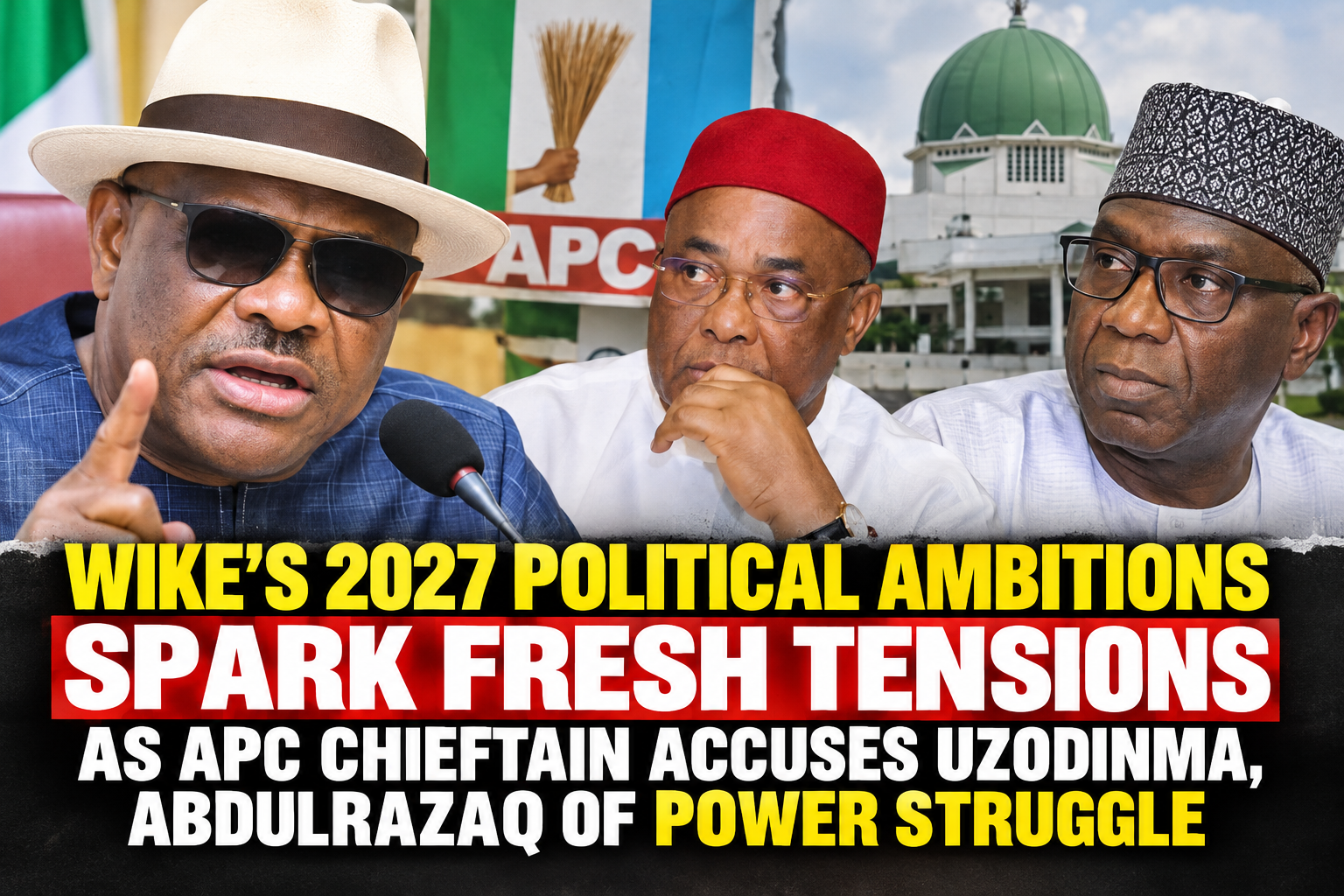
The ongoing political face-off between Minister of the Federal Capital Territory (FCT), Nyesom Wike, and some All Progressives Congress (APC) governors has been linked to alleged personal political ambitions ahead of the 2027 general elections.
APC chieftain and member of the Otoge Progressives in Kwara State, Tajudeen Olesin, claimed that the political ambitions of Imo State Governor, Hope Uzodinma, and Kwara State Governor, AbdulRahman AbdulRazaq, were partly responsible for their disagreement with Wike.
Naija News learnt that Olesin and other aggrieved APC leaders in Kwara State have declared their support for Wike’s Rainbow Coalition, a political movement that has continued to generate debate within Nigeria’s political landscape.
Speaking in an interview with Punch, Olesin alleged that Governor Uzodinma was positioning himself to become the Senate President in 2027, while Wike was backing the return of the incumbent Senate President, Godswill Akpabio.
According to Olesin, Uzodinma may seek to resign as governor before the end of his tenure, hand over the governorship to his deputy, and contest for a senatorial seat with the ambition of becoming Senate President.
He further claimed that Wike had indicated that he would not support a Southeast candidate for the Senate presidency if President Bola Ahmed Tinubu sought re-election in 2027.
Olesin said:
“What is happening is that Imo State Governor, Hope Uzodinma, wants to become the Senate President in 2027, whereas his governorship will finish by 2028. He plans to resign and give the governorship seat to his deputy, become a senator and contest for the position of Senate President.
“But Wike said he couldn’t support somebody from the South-East. If Asiwaju is coming back as the President, let the Senate President, Godswill Akpabio, come back as well. That is why Uzodinma and the Kwara State Governor are fighting Wike.”
Kwara Governor’s Aide Accuses Wike of 2031 Presidential Ambition
Reacting to the allegations, Special Adviser on Party Affairs to Governor AbdulRahman AbdulRazaq, Mashood Alaka, offered a different interpretation of Wike’s political activities.
Alaka alleged that Wike’s Rainbow Coalition was designed to establish a broad political network that could position the FCT minister for a possible presidential bid in 2031.
He claimed that Wike’s support for President Tinubu’s re-election was part of a broader strategy to build alliances with politicians across party lines, particularly state governors, ahead of the next presidential election cycle.
The Kwara governor’s aide also questioned Wike’s decision to support Tinubu’s presidential ambition while allegedly backing opposition candidates for seats in the National Assembly.
According to Alaka, Wike should either remain in the Peoples Democratic Party (PDP) and operate within the opposition or formally join the APC if he intended to participate in its political structure.
He maintained that the APC had the capacity to secure President Tinubu’s re-election without relying on Wike’s coalition.
Alaka said:
“What Wike said to the APC governors, especially Mallam AbdulRahman AbdulRazaq and Governor Hope Uzodinma, is out of order. He is a former governor and he knows how things work.
“The whole coalition thing is to mislead the APC into believing he is for them. Everybody knows that he has his own ambitions and is trying to get some of the governors to his side in 2027 ahead of 2031, so that he can be well-positioned to contest for the presidency.
“If you want to stay in the PDP, stay in the PDP. If you want to work with the APC, work with the APC.
“If truly he is supporting Mr President, he shouldn’t be fielding candidates for the National Assembly. If Mr President wins and his party is in the minority at the National Assembly, it is going to be an issue at the end of the day.”
Political Implications of the Dispute
The allegations reflect disagreements over political alliances, control of legislative leadership, and the direction of Nigeria’s political alignments ahead of 2027 and beyond.
While Olesin attributed the disagreement to alleged ambitions surrounding the Senate presidency, Alaka argued that Wike’s coalition was connected to longer-term presidential positioning. The claims are allegations made by the respective political actors and should not be treated as independently established facts.
The dispute also highlights tensions surrounding cross-party alliances and the relationship between support for a presidential candidate and political competition for National Assembly seats.